
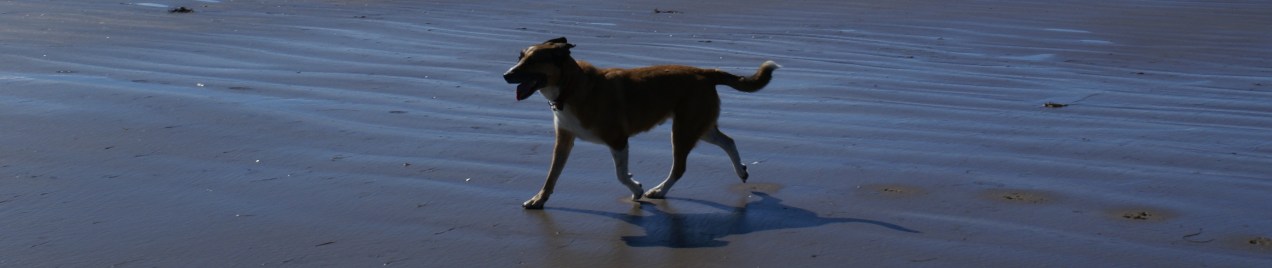
My dog can’t read – but he can smell where I’ve been.
He can eloquently remind me when I forget something in our shared routine. He does this by urgently engaging my attention by gazing through my eyes into my mind then shooting a glance in the direction of the task that I have forgotten (usually one that he enjoys). His body-clock is not, like mine, regulated by an unreliable stomach – it has pin-point accuracy, ‘Gosh, is that the time Pedro (that’s his name) you’re right, we’d better feed the sheep before it gets dark,’ or, more likely, ‘Alright! Alright! Don’t nag — I hadn‘t forgotten!’ which I had.
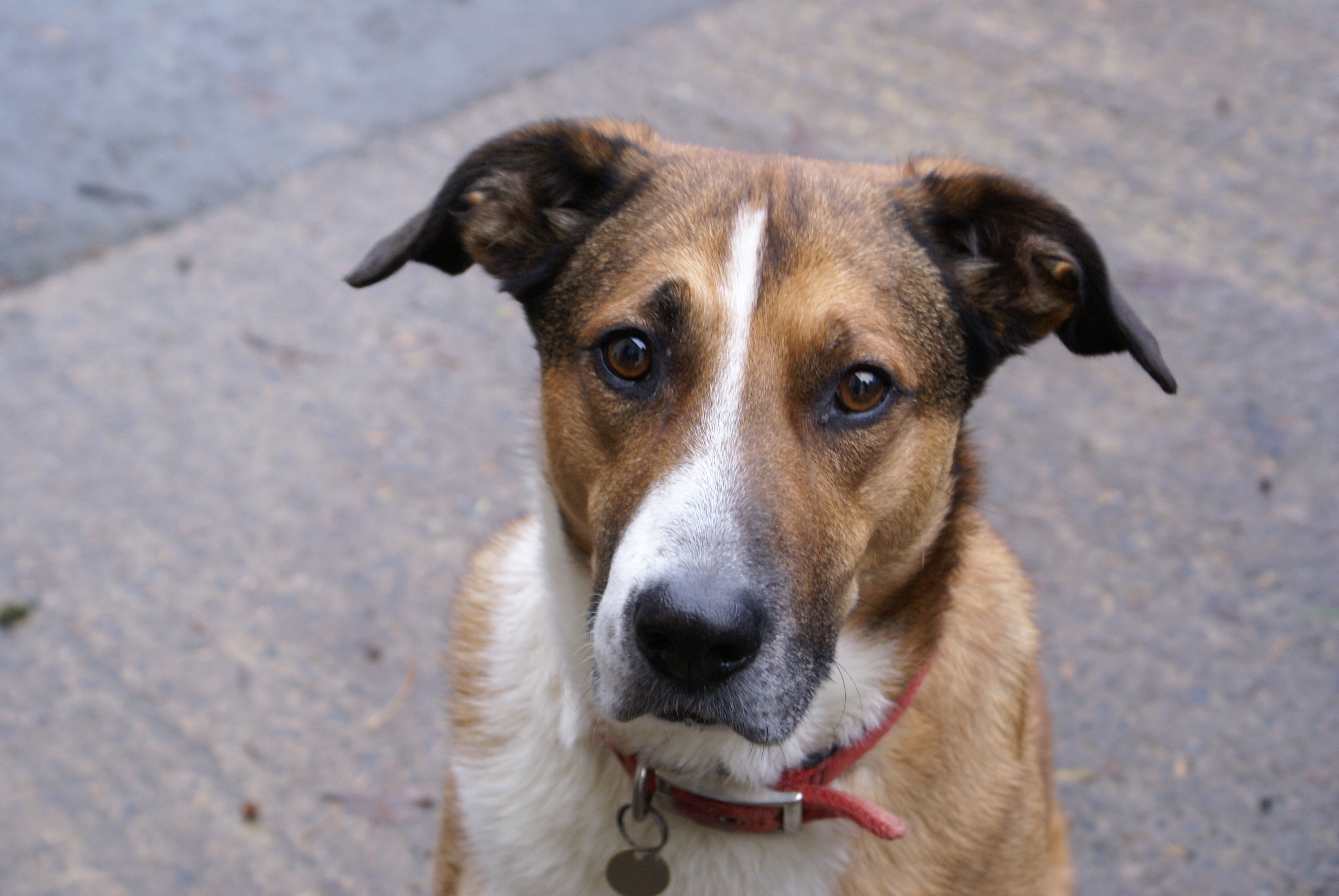
‘What did you say?’ asks my husband.
‘I was talking to the dog!’
His empathy is as finely tuned as his sense of smell (the dog, not my husband). He knows exactly what I am feeling and he is not alone in this – I read of a dentist who had the greatest difficulty in separating his blind and nervous client from his guide dog — you’ve never heard such a kerfuffle. Not until the master had removed his fluorescent harness, rendering him off duty, would the dog sit edgily in the waiting room.
The point I’m trying to make is that in pursuit of more and more exacting verbal communication we may be missing something.
My dog can’t text
but uses the internet-
BT

- reading pee-mail

- sending pee-mail
Non-verbal conversations can be the most eloquent, exchanged in an instant, are fluent in different languages, understood by other species and are rich in emotional content.

If you ask any parent who has a child on the other side of the world if they’d rather video-call or have a conventional telephone call they’ll tell you the importance of seeing their loved one’s face to know how they really are.
I suspect that, like everything in nature, the ability to talk without words is normally distributed, some of us have a lot of it and some of us have very little and most of us are somewhere in the middle. I think that where we are on this spectrum is probably, like most things, a bit genetic and a bit learned. I have had two babies, both normal: one arrived as a blank canvas and learned facial expression gradually by watching and mimicking, the other came out of the womb with, to our surprise, a complete repertoire of facial expressions. Right from the beginning this child could express, pleasure, disgust, alarm, fear, pain, puzzlement, interest, attraction, satisfaction, surprise and wind. Children like this are an open book and can engage more easily and earlier with others – we are not all born equal.
For those children born at the opposite end of the spectrum, endowed with little inherent understanding and deprived of opportunities to learn from others all those non-verbal cues that inform us about what other people (and my dog) are thinking, for whom other people’s thoughts are a mystery, life is confusing. It is as if all their social interaction is by telephone. Worse than that: even the non-verbal elements of speech are removed; the secrets of prosody are hidden, the nuances of intonation and rhythm in speech that can change a statement into a challenge, or a rebuke, or a question, or just a ruminative echo.
The question is: when Nature alters brain structure or function a little further in one direction so that we notice it and call it a syndrome, what is it making room for? What new possibilities may be opening to us.
I also read (in the Christmas Good Housekeeping, or maybe it was Prima – I went to the dentist this week) of a little boy with Asperger’s syndrome (which includes difficulties in understanding the non-verbal) who was helped by having a cat – this brings us full circle to my dog who has no words but communicates perfectly and could, like the cat in the article, teach others the art of non-verbal communication by repeated reinforcement without any parental pressure or angst.

http://dailypost.wordpress.com/2013/12/09/multimedia-storytelling-challenge
 dianaashworth