British history, Humour, Local History, Travel

Discovering Shrewsbury…

Although I’ve lived within 50 miles of this, the county town of Shropshire, for 20 years, I’ve never really had the time to look at it properly — always rushing for a hospital appointment, changing trains or dashing back for some imperative.
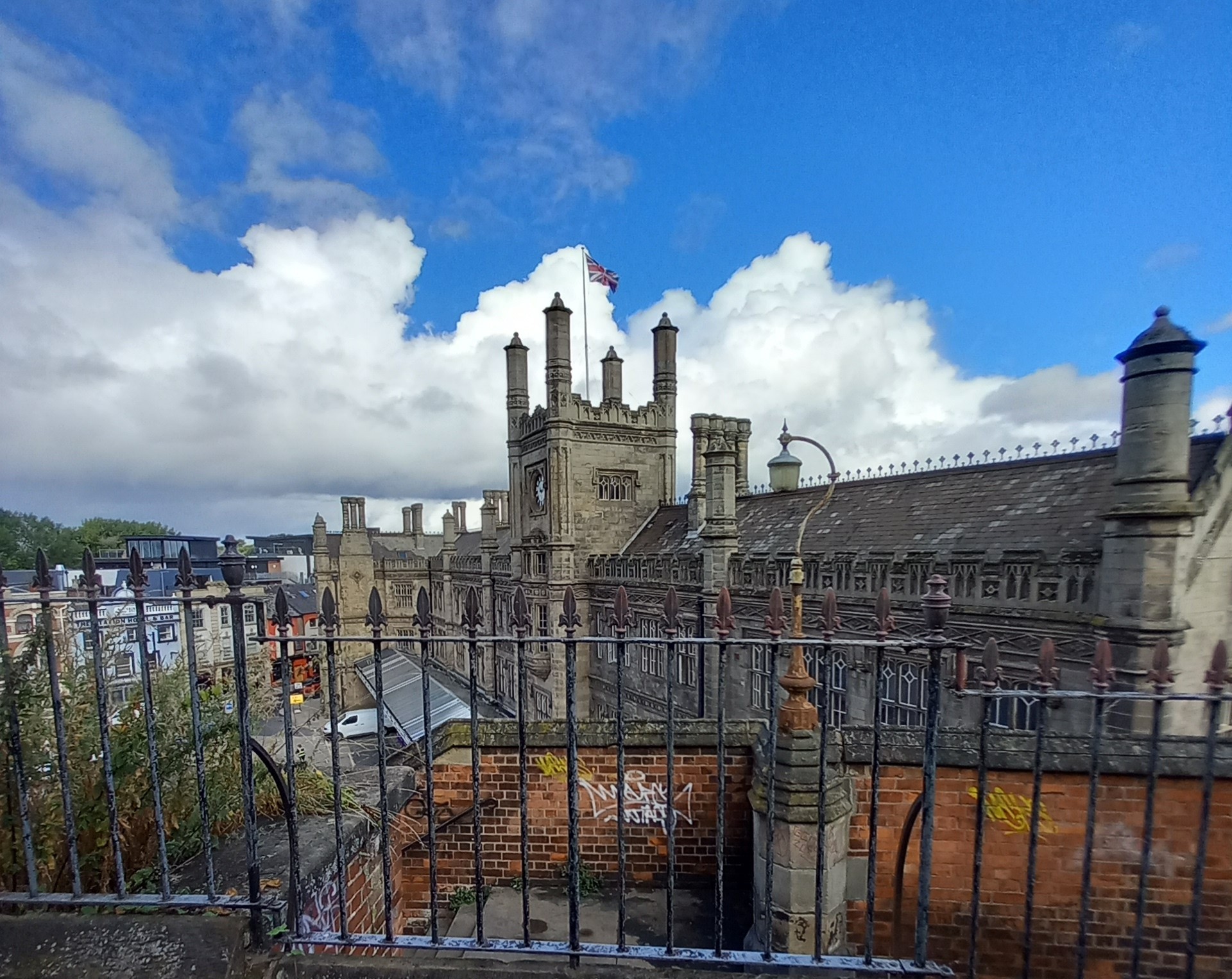
Last week we took my friend, Anne, to catch a train to Yorkshire — she had a tortuous journey ahead so, despite the traffic (we do not expect it in Wales), we opted to drop her at the historic railway station (above) where we ejected her unceremoniously and to much furious and unsympathetic honking. “No cars!” said the entrance to the carpark, “Bicycles only!” Nobody actually mowed us down as I hauled her luggage from the boot and we found the platform up 28 steps (lift out of order) taken at a trot with her heavy bags — fortunately the train was 3 minutes late and we had 15 seconds to spare.

Having found somewhere to leave the car legally, Bill had to buy a ticket which fortuitously brought him to the booking office where, having waved off my friend, I was wondering what to do next and where he might be — it seems for once the stars were aligning for a good day out!
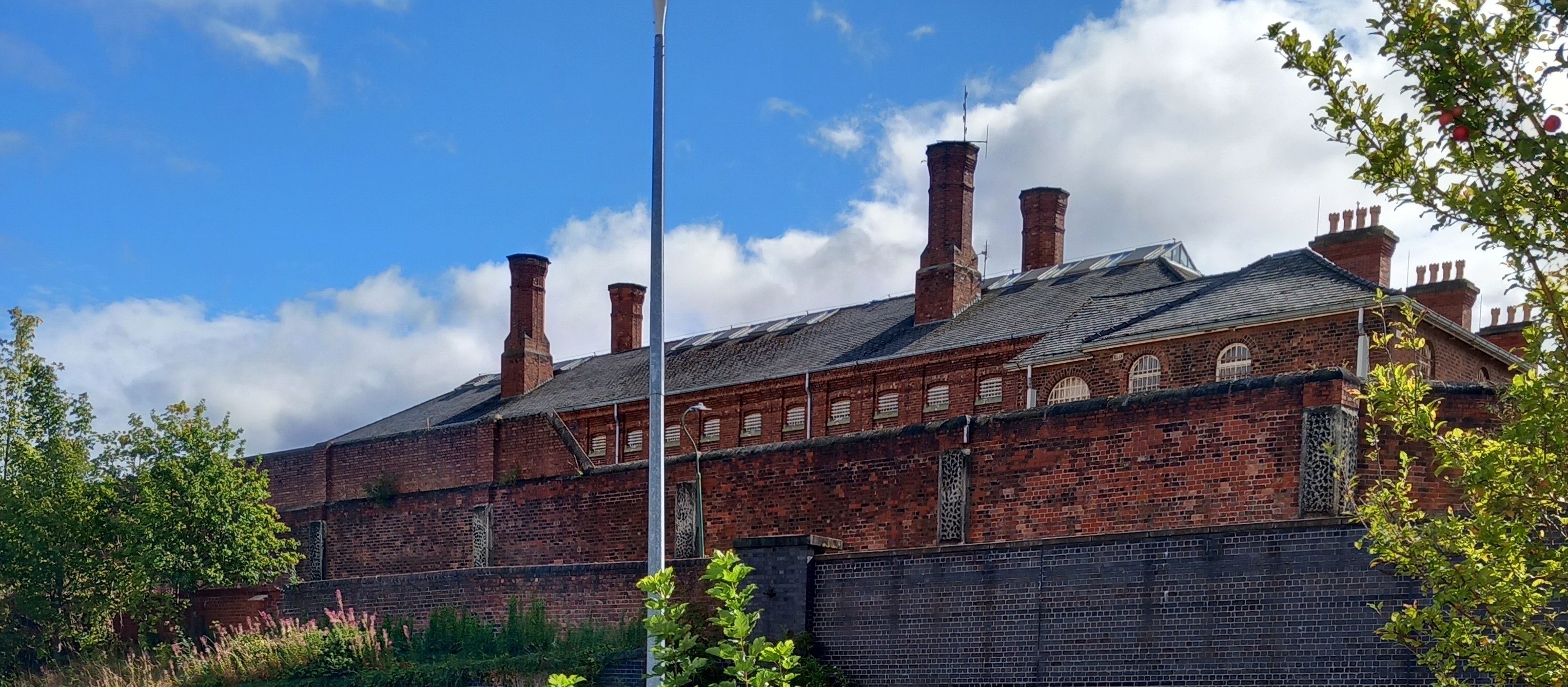
Shrewsbury Prison is a smouldering presence above the carpark, built in 1793 by Telford, designed by local architect John Hiram Haycock and William Blackburn, advised by John Howard the famous prison reformer who looks down from his plinth above the gate. You can book a tour and even stay the night in a cell, “That’s an idea!” says I with my Granny hat on.

Here’s another famous citizen, Clive of India, getting more infamous by the day as we look at empire from a different angle now — still he hasn’t been toppled from his plinth yet.

The town is full of tantalising mediaeval alleyways– note how the common gutter has been replaced by festive commercial waste bins — I miss the piglets, dogs and red kites scavenging on the waste!

The marvellous market has moved indoors but still bristles with prime produce. As we amble around town the clouds are gathering and the tempting aromas start to emanate from the various eateries. Our noses led us to La Mer Rouge for delicious tapas and to watch the torrential rain in comfort. Behind the old market hall is the town museum and art gallery, irresistible!

Mermaids and dolphins vase, made by Walter Crane Maw and co, Broseley (Shropshire) c1889.

Also the findings from Wroxeter, the 4th largest city in Roman Britain (Vironium) just beyond the modern bypass — both to be explored in Granny hat.

Shrewsbury has been an important place ever since, at the gateway to Wales, a strategic and wool trading centre. Fortunes were made.

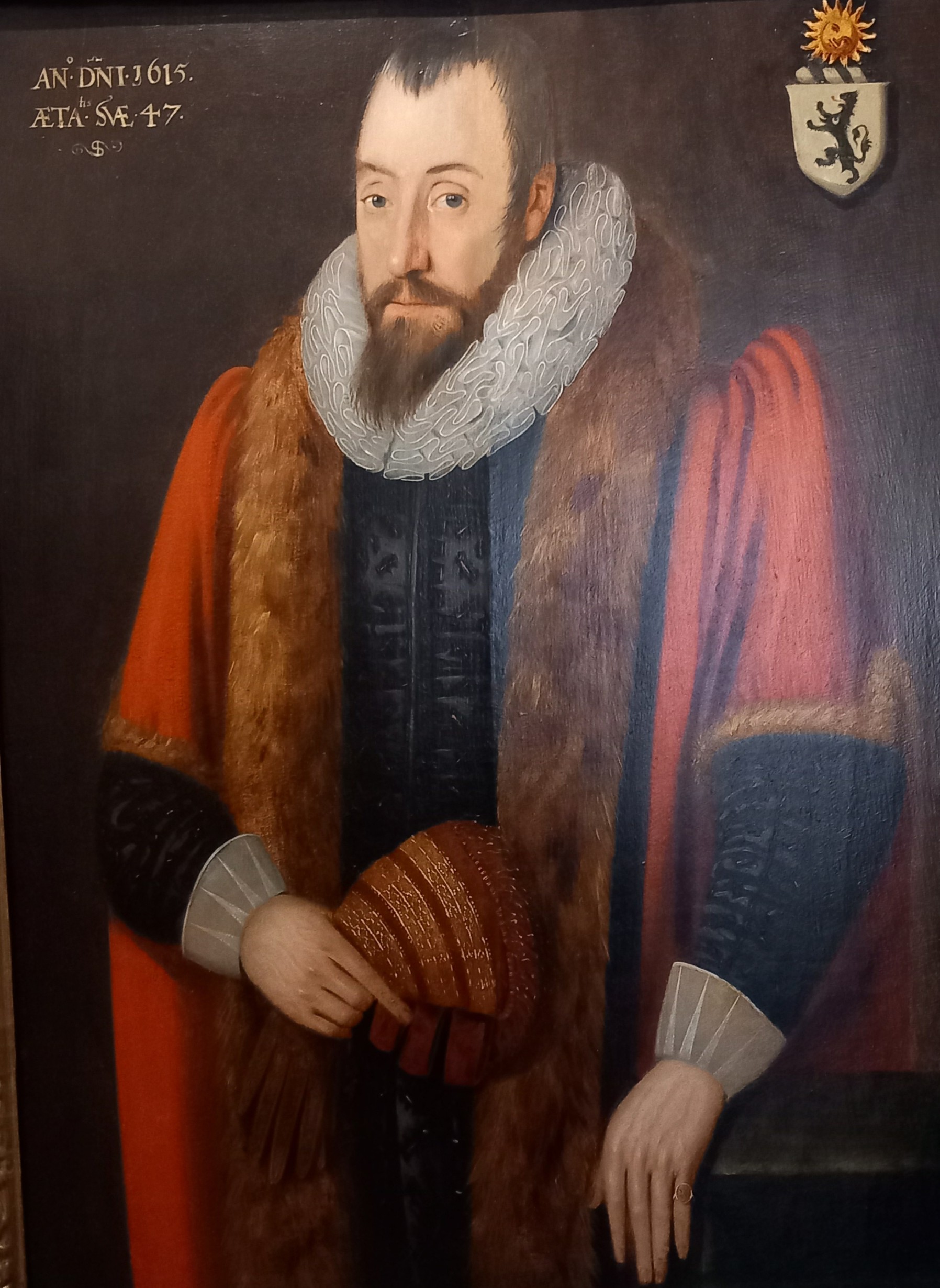
In Stuart times one of these rich wool traders, Thomas Jones, pictured below in 1615, married Sarah Ballard, the educated daughter of the Mayor of Chester. Thomas rose in the local hierarchy as an alderman, then Bailiff and finally Mayor in 1638.
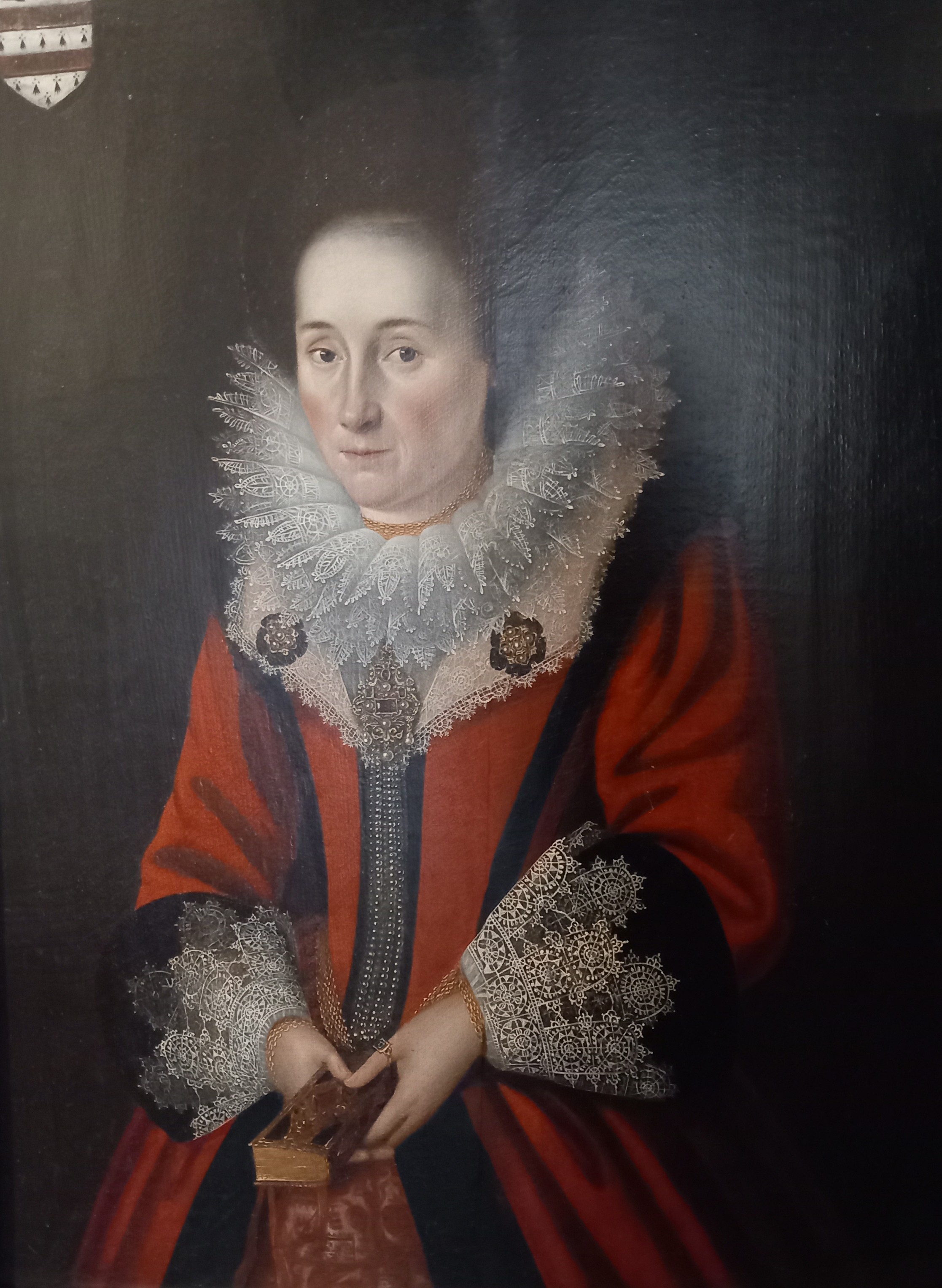
At the beginning of the Civil War (1642-1651), one man, Francis Ottley, seen below with his family in 1636, was appointed Governor of Shrewsbury by Charles I, who called on him to form a regiment of foot. These were divisive times with mixed loyalties. He carried the town along the Royalist path. Francis was appointed Sheriff of Shropshire in 1644 and, as the tide turned, was involved in negotiating the surrender to the Parliamentarians in 1646 after which his estates were sequestrated. He paid a price for his loyalty to the Crown spending the rest of his life fighting to retrieve his estates at Pitchford. However, It seems he negotiated these treacherous times, relatively successfully as his family remained prominent after the war and for centuries thereafter.

It may be significant that Sir Francis Ottley had been criticised by Prince Rupert, when in power, for being too lenient with Parliamentarians — Perhaps that was his salvation… One never knows when the boot will be on the other foot! (personal note)

For all the above, the highlight of our visit was the discovery of the Castle Museum and the history of the King’s Shropshire Light Infantry, a magnificently curated museum deserving another visit and a blog of it’s own.

Standard
Humour, Local History, Wales

Under Fire!

The first of February was the last day of the season for shooting pheasants in the United Kingdom and presumably the last day for taking pot-shots at innocent little ladies walking in the woods which is what my friend and I were doing that day.

Hoods up against the sharp wind, we leaned on our stout sticks and felt our way through the frozen puddles along the bridal track from Bwlch y Ffridd to Gregynog Hall — so muffled were we that we could have passed for the ghosts of Margaret and Gwendoline Davies, the great patrons of modern art, who will have passed this way a century ago.

“That’s where von Ribbentrop used to stay in the thirties,” said my friend pointing out a building on the far side of the wide valley. I pricked up my ears but before I could question her further we became aware of several large four-wheel-drive vehicles crunching through the snow in the valley below and stopping one after the other to disgorge men with guns who seemed to be scrambling to take up positions along the valley, parallel with our route along the track. “Are they hunting today? Is it a shoot?”

“Shootings over for this year… I think” said my friend.

Young men with dogs and sticks appeared above us in the wood lashing at the tree trunks and clapping.

“Beaters?”

“I think we had better turn back and quickly.”

Bang!

“They are bloody shooting!” In a state of extreme arousal we slid and stumbled our way past the gunmen, along a fusillade that rained lead shot down through the trees like unearthly hail. They weren’t firing at us and probably were 30 feet away but it really was quite exciting!

I bet von Ribbentrop came here for the shooting or perhaps to meet Mrs Simpson (lovers evidently) as they both wooed the future king — it’s a small world.

Standard
Democracy, Local History, Wales

Time warp

Llanidloes hasn’t changed much in two hundred and fifty years.  Take away the cars, cover the yellow lines with horse manure and replace the plastic awnings of the market stalls with canvas ones and you could be back in 1749 when John Wesley, evangelical Nonconformist rode into town and stood and preached on the stone by the market hall where dogs today, as they have for centuries, cock their legs.

?????????????????????????????

?????????????????????????????

1839 was the year that the people of the town rioted because three London police constables were sent to arrest the leaders of the town’s Chartist union.  The Chartists believed in one-man-one-vote, a secret ballot, annual elections, pay for Members of Parliament and the abolition of financial and property qualifications for MPs and that each parliamentary constituency should contain the same number of voters.  That is all.  The authorities were so unnerved that the little town of two thousand people was occupied by the military for twelve months.  It had taken five days for the troops to arrive in this remote part of Wales and this was known as the ‘Five Days of Freedom’, our ‘Celtic Spring’.

Townsfolk stormed this building to free the Chartists

Townsfolk stormed this building to free the Chartists

Yesterday was St.David’s Day, and the market was held as it is every Saturday and has been for centuries:

It is the first town on the River Severn, set in the most beautiful countryside, a good place for the dawn of democracy and a cracking place to do your shopping.  The small independent shops and market stalls, between them, can  service the towns every need.

Standard
Local History, Uncategorized

Man Eats Dog

I have been writing the biography of a man who lived in Wales through the depression of the 1930s; he was a famous international amateur footballer but also a notorious poacher and wit; I have been reading endless accounts of long forgotten football matches and interviewing his large family and friends, hearing their stories and cobbling together some sort of narrative.  The interesting thing is how it demonstrates the nature of story telling.

When someone repeats someone else’s oft-repeated anecdote it is sometimes difficult to be sure what the point of the tale is.  The chap I was writing about told his children many times about going to help a farmer with the harvest and noticing that the farmer’s dog was nowhere to be seen.  Later for lunch they had a stew of unusual white meat that the original teller of the tale remained convinced was the dog.

Man eats dog — what was the point.  He had repeated the story throughout his life — it had made a big impression on him him.

Was he disgusted?  What did he say it was like?   Quite tasty.

Meanwhile I was struggling with my hero’s poaching, not just the stealing but the ecology, as locally long-extinct species appeared in the family pot and fish roes were boiled up, in the breeding season, for bait.

Then I remembered the poor farmer’s wife with all those hungry helpers come to take in the harvest with no payment in prospect apart from one decent meal and my hero’s narrative reached me over the years.

Image

H.B. ‘Gurra’ Mills in about 1923 — reproduced thanks to his family.

You can access his full biography on the ‘Published Work’ page of this website.

Standard