Birds, Medical

Survival? Against All the Odds.

I didn’t see the accident — just the blood on the road as I swerved to miss her as she  staggered blindly in my way.  I stopped and the cars behind were already pulling out to overtake me,  I  switched on the hazard warning-lights, jumped out and ran back.

No one else stopped —  they hadn’t seen her — now she lay helpless in the gutter — I had to be quick or there would be another accident.

I could smell her blood, it was on my hands as I tried to hold her — steady her.  She struggled and kicked — there were two huge gashes on her head, I could see the bone, liquid was bubbling from one of her eyes and blood was coming from her nostrils, strangely the cars whizzed past, their drivers oblivious to the drama.

I had nothing with which to do anything.  I ran back to the car and found some carrier bags and the dog’s lead (no first aid kit of course) — anyway there was no time for that.  I tore the bags flat and wrapped her in them, swaddling the little duck like a baby and trussed her up with the dogs lead so that she would not injure herself any more — she calmed.  I lay her in the dark boot of the car wedging her in so she wouldn’t roll about then closed the lid.

Now I could have driven to town, to the vet — yes, she was  (and still is) a duck — a little mallard, hit by a car — well she probably flew into the moving vehicle — she was, is after all, female — but I did not.  I’ve seen the expression on their faces when you present them with a wild thing and I’ve paid the price!

No, I took her home.  My husband groaned and, once again, our wet-room came into it’s own.
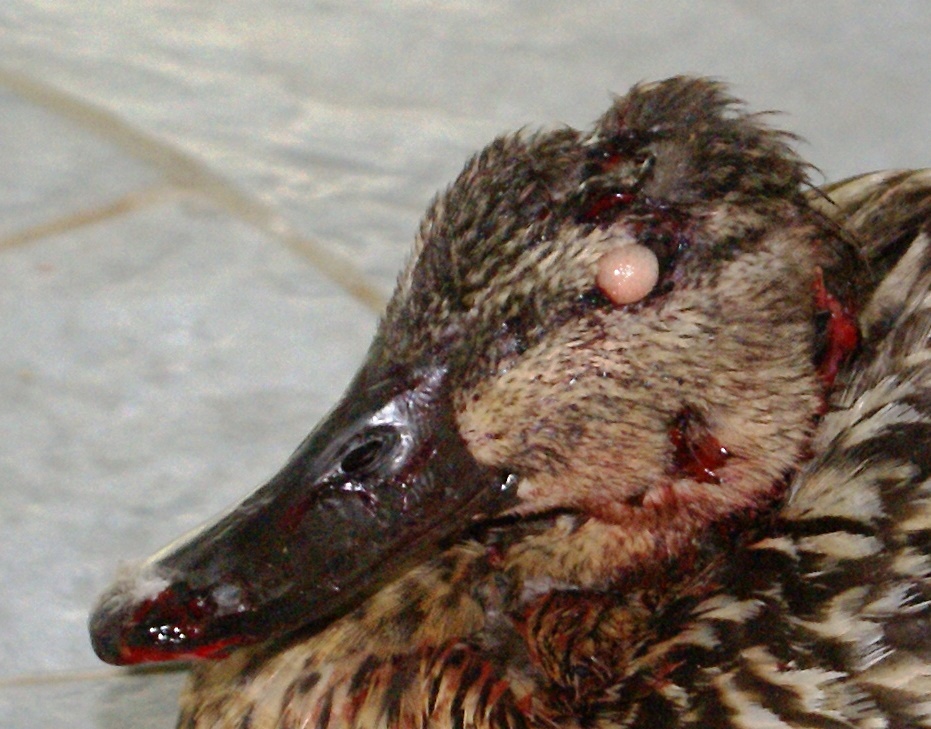
?????????????????????????????Trying to walk, she repeatedly toppled over to the right but in the half light of the darkened shower room she settled and sat quietly all that day and all the next.  Nothing ate her.  She moved around a little but would not eat the slugs which I had collected for her and which climbed their slimy way circuitously to the ceiling , nor did she try the bread in water which she spilled, nor the caterpillars that pupated on the tap.

On the third day, she was thin, dehydrated and matted but walked more steadily and looked up at me as if she saw me.   We had to go away to a funeral the next day so first thing in the morning I carried her to our pond and put her down gently by its side.  All the way there she was looking from side to side  as if getting her bearings..  Next thing she topples forward and plop!  She’s in the water, she lowers her head so that the pond water flows into her beak and she takes a long cool drink and paddles off purposefully around the margin  of the pond.

Away to safety.

Away to safety.

On the far side she climbs out onto the bank under the muddy cliff where the water from the spring  runs down in a curtain.  She settles there washed by the tiny waterfall.

Next evening when we return she is still there.  She watches me throw bread on the water then stands up straight and flaps her wings two or three times to test them, shakes herself and settles down again.
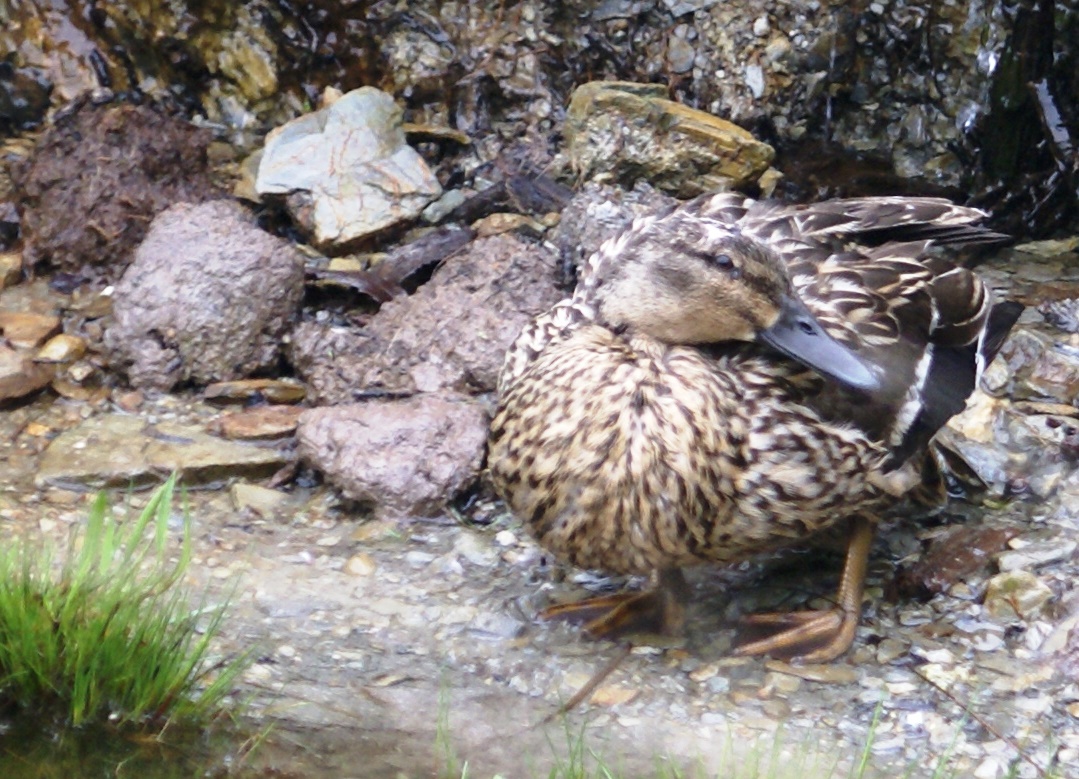
Camouflaged.

Camouflaged.


Next morning the bread is gone and so is she, flown away or carried off by a fox.  But wait…

What's that?

What’s that?

There she is, sitting near the path, ready for breakfast.

Breakfast!

Breakfast!

We have a friend who is a farmer, when asked if he has to get up a lot in the night for his animals he says, ‘No, God does the night shift.’

?????????????????????????????


Standard
Wales

First Footprint in the Sand

It is exciting to discover the unexpected — that’s the marvel of Wales.  You can walk over a hill and stumble into the unexpected –not an upland bog but a Roman hill-fort,  a medieval rabbit warren, a bronze age settlement or simply an unbelievable view.  Often there is nothing on the map — many minor ancient monuments remain unknown or long forgotten.

Yesterday my daughter and I went to explore the Dysynni Valley where we knew there was a magic castle, now ruined, in what my daughter described when we got there as probably the most beautiful place she has ever been.  There is a sign from the road and a single information board at its entry which is a wooden kissing gate with no fasten, no attendant, no charge and no sign of any other visitors although we did come across two elderly couples coming down the path as we walked up.

?????????????????????????????

Castell-y-Bere was built by Prince Llewelyn ab Iorwerth (the great) in the 1220’s, it was captured by the English under King Edward I, from Llewelyn’s grandson (Llewelyn ap Gruffudd — pronounced Griffith– and not so great) in 1282 and later abandoned by the English after a considerable battering and a fire in about 1294 at the hands of Madoc ap Llewelyn.  It was never very practical as it could not be supplied by sea.

The views are stunning.  There is a wide flat valley where one can imagine the sea coming into the estuary and washing the lower ramparts  and breaking against the nearby tall sea cliffs — but this was not the case —  the sea had long gone even then but the birds that nested on this rocky coast have always remained.

Bird Rock

Bird Rock

Yesterday, as we looked up at Craig yr Aderyn, Bird Rock, towering nearby, there was only one thing we bold explorers could do in the spring sunshine perfumed by may blossom  — we had to climb from the castle mound to the top of the ancient sea-cliff to look down.

We passed not a single human, there were no signs and no restrictions, only one love-lorn chaffinch singing most beautifully to its mate in the tree above and so absorbed that he was oblivious to us and our dog.

?????????????????????????????Further up the path the hardy sheep were not so amenable, they stamped their feet aggressively at Pedro on his best behavior and on a lead and when one of these ginger-footed psycho-sheep found itself separated from the rest it squawked like  the eponymous creature of the rock…  Then lost its nerve and ran behind an outcrop to hide.

Psycho-sheep

Psycho-sheep

????????????????????????????? After an 850 foot climb we were on top of the world, looking down.  We saw the sun sinking  towards the sea in Cardigan Bay — a bird’s eye view of the valley.

Cormorants stand on the highest outcrops of the cliff face stretching out their wings to dry in the evening sun, this is their only inland nesting site in Wales.  We can look down on circling gulls and strain our eyes to pick out the red beaks of the choughs (pronounced chuffs — shiny black crows with finger-tipped wings, red down-turned beaks and red legs). This is one of their rare nesting sites, a place where the sheep graze down the sward and no-one kills the insects — just how they like it.  Here they wing their way around the crags throughout the year having aerial skirmishes with gulls and swooping down to bounce off the side of the steep hill.

As we came down, picking our way over a bank of stones which meanders around the side of the summit farthest from the valley we remarked that it looked like a fallen dry stone wall, but then there were two larger mounds of haphazard stone — perhaps not entirely haphazard —  we can see courses, still just discernable in the heap — a tumble down watch tower perhaps — there you go again — ?????????????????????????????first footprint in the sand…  Turns out there were two — towers, not footprints!.


Standard
Wales

Hiraeth

?????????????????????????????

 Hiraeth — one of the most important words in the Welsh language yet without an exact equivalent in English — that says it all really.

An Englishman would say homesickness — a negative feeling that unsettles you and stops you doing your job properly.  In the Celtic vernacular hiraeth is a sense of incompleteness tinged with longing — it embodies the spirit, the beauty of the landscape and the belonging.

It is that feeling we have at dusk, in the bluebell wood — it is love — it is God —  it is home.

Standard
Ecology

A Miracle? That’s what we need.

It is an apparition — a visitation — something from beyond our world — or perhaps from a time long gone —  extinct in Wales for decades, centuries — usually only seen with the dragons and griffons on coats of arms drawn long ago.  It is the Welsh fish-hawk, gweilch y pysgod,  hovering once more over the shallow waters and mud flats of the Dovey (Dyfi) estuary: an osprey.SONY DSCThe strenuous attempts of local, national and international ornithologists have been successful in luring back a single pair of nesting ‘fish eagles’ to a  muddy, midgey corner of Wales.  The female now sits on an untidy nest on a man-made platform at the top of a very tall pole.  They have returned from West Africa, where they migrate, to breed and lay their eggs.  She incubates them while fed by her mate who fishes in the waters around.  She looks out, moving her head jerkily to scan for intruders and all the while the CCTV mounted on the nearby pole scans her — recording her every movement and the visits of the male and those of the little train that clatters past every hour, around the water’s edge on its way to and from the university town of Aberystwyth.  Students on the train, often of natural sciences, know she is there and point her out to fellow travelers.

The nest is a place of pilgrimage — a birdy shrine.  Birdy folk come, they walk the half mile along the new board-walk to the soft-wood cathedral in the marsh — the new observation tower.

From the weather proof lounge at the top they can divest themselves of their long distance lenses and state-of-the-art cameras and unwrap their sandwiches.  There is a telescope fixed on the precise spot and, once you know it is there, you can indeed just see the nest platform with the naked eye and once you get the image home and magnify it — bingo:

The live-feed from the CCTV is excellent (you can view it online) — displayed on wide screens in the cathedral and at journey’s end — the gift shop.  It is also transmitted to the hide near the car park  for those who cannot make the pilgrimage along the board-walk through the peaceful marsh where only the dim twitter of warblers and reed bunting reminds us that this is a habitat — a sanctuary for birds — you can’t blame the usual inhabitants for keeping their heads down today — there is an osprey about!.

Thanks to Montgomeryshire Wildlife Trust for their permission to show photographs Creative Commons License   taken from their live feed.  View the birds yourself at http://www.montwt.co.uk

Dovey Estuary

Dovey Estuary

Standard
Hill Farming, Lyrical, Sheep

A strange, still wind

Crow craw and jack-daw puncture the sound-scape of hills and meadows – aerial battle resounds – broadsides ricochet in the pale sky above the passerine chit-chat and base-line baas of our valley.

A new chord rises – the dog points, ears pricked, and sniffs.

A strange, still wind?

Rumble of some terrible upheaval?

Discord?

Birds pause. Listen!

It rises from the supernatural, our eternal underworld – louder – voices more distinct — celestial choir – angel voices.

Twenty-five thousand souls look up from grazing and acknowledge their lord, each with a different note from the human range – angel range.

Audible crescendo from three miles away — each note swelling with excitement, a wave of emotion to touch the very core…   Now the melody is with the base – diesel baritone — and percussion over the cattle grid.

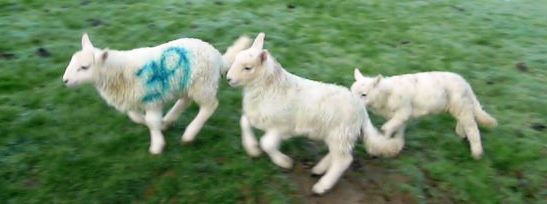
Lambs2014 009gambolling


Standard
Thoughtful

Why Blog?

Lambs2014 009gambolling

Why blog?

I blog because when someone asks ‘What have you been up to lately?’ my mind goes a  blank and when I ask myself, ‘What’s it all about?’  I don’t always know.  These days my concentration is so much upon the now that I lose perspective.

Once it’s logged and blogged and photographed it’s there to be recalled, it is fixed in the narrative — made sense of — preserved — formatted for storage.

So, sorry to say, I write for myself and my family and for friends who might say ‘What have you been up to lately?’

When I ask, ‘What’s it all about?’ I can have a litttle browse and remember all the amazing things that we have — meanwhile you are very welcome to share and if you are a little obsessed by sheep and blown away by Nature — so much the better!

Link
Ecology, Humour, Medical

What you need is a CT scan, 400 Chest X-rays or 1200 packets of Brazil Nuts.

‘What you need is a scan’

‘What, like you have when you are pregnant?’

‘No, a CT scan, computer tomogram — that’s the only way they can really tell what’s going on — but they’ll try to fob you off with painkillers, they always do!’

My friend’s bad knee continued to be discussed in the pub, no one said she ought to lose weight, change her footwear or work on her quads.  Everyone quoted their own experiences, all were unanimous — what she needed was a scan.

That’s equivalent to 8 chest X-rays –okay, probably worth the risk.

But I went to see a gastro-enterologist recently to discuss my mild indigestion during which consultation I mentioned that a relative had died of pancreatic cancer — ‘then you had better have a CT scan!’

He reached for his pad, it was 7.30 pm, I was his last patient, he looked tired.

‘Hang on a minute — what dose of radiation will that involve me in?’

‘About 8 milliSieverts, same as about 400 chest X-rays.’  He said this very quickly, ‘equivalent to sitting at home for three years watching the telly, enjoying the background radiation.’

‘That seems a bit extreme.  I mean having a scan.’

‘Everyone has a CT scan these days, it’s the only way to be sure,’ he said, ‘I don’t mind  — you can have one.  It will almost certainly be negative but then you won’t have to worry.’

But I do worry — 3 years back-ground radiation — that sounds like I’m suddenly 3 years older — three years nearer whatever I do die of.  So I went home to wait for my appointment and looked up one or two things…

Did you know that the average person in Great Britain is exposed to 2.7mSv per year?  This is from radon in the air, radioactivity in the rocks, soil, and plants and manufactured radiation, largely medical.  The radiation in the soil  gets into plants that we eat — you can get 0.005 mSv from one little packet of Brazil nuts (135g).  My CT scan is worth 1200 packets of nuts — there’s a thought.

The background radiation is largely unavoidable and varies a bit according to where you live — radon from the ground in Cornwall gives an annual exposure of 7.8 mSv — so my CT scan is equivalent to a year in Cornwall — that doesn’t sound too bad — unless you live in Cornwall.

Radiation exposure also depends on how high you live, the nearer you are to outer-space, every transatlantic flight you take racks up 0.07 mSv (just over 3 chest x-rays or more than 5 packets of Brazils!)  If you live in Denver, Colorado (mile high city) your background radiation will be twice as much as some other places.

Tobacco  contains Polonium-210 and Lead-210, these are radioactive and become concentrated in he lungs of smokers, the US Environmental Protection Agency quote  that smoking 20 a day gives a radiation exposure equivalent to 300 Chest X-rays or  6mSv/year

Without smoking, the average person in the USA is exposed to 6.2 mSv of radiation per year, more than double the British level (unless you live in Cornwall)  If you look at the different components of these figures, most of the difference is made up by, guess what — medical radiation.

When I first visited the US 20 years ago, I saw a lot that was strange to me — shopping malls, retail parks on the edges of towns with neon signs, ice machines, burger bars and super-sized paper cups, stacks of pancakes with syrup and ice-cream and Tommy Hilfiger clothes  — all are now common-place in Britain.  From jazz and rock-‘n-roll to obesity, what starts in the US comes to us in 15 years or less.

So I guess this trend for scans will continue and I will watch the cancer rates in the US for indications of what is to come here.  In the meantime, I think I might cancel my scan because, do you know, I think I feel better.

Thanks to Panoraia Paraskeva et al for the featured image of a CT scan via Wikimedia (CC-BY-SA-2.0)
Also thanks to Public Health England for the figures for relative doses of radiation.
Standard
Hill Farming, Relationships, Sheep, Uncategorized

Love Potion — Or why you shouldn’t wash new born babies!

The secret behind creating the most powerful emotional bond ever known is revealed — remembered from our primaeval past.  It occurred to me as it probably did to our ancient ancestors — when it went wrong.

Yesterday we had to leave our lambing flock for a few hours, it was an imperative.  A friend had agreed to come as a locum (in between lambing a 180-ewe batch of his own sheep) but he wouldn’t get here until after we had left.

?????????????????????????????

I rose at 5.15 am to check and feed the flock — chaos reigned.

Two ewes were fighting ferociously over a new born lamb that was trying to suckle from the younger one, Number Nineteen (you know they are not supposed to have names).  Every time the lamb got near the teat the older ewe, Square Sheep (who you have met before) interposed herself with frantic baaing and butting of the younger ewe.  I chased her off but she would not leave the lamb and with her four-wheel drive and superior power-to-weight ratio I was not going to prevail.  I looked around for inspiration.

All I saw was a square wooly bottom.  A long silken thread of liquor glistened from it in the morning sun.  Square Sheep had given birth, she was right — it was her lamb.  She looked at me accusingly and who could blame her?  Still the battle raged.

The fence was nearby — I ran down the steep hill to the barn, 200 meters away, and returned with a hurdle (a galvanized fence panel — 2 meters long and quite heavy) then I got the other one and a pocket full of baler twine.  I tied them in a V to make the apex of a triangular pen with the fence as its base.

At this point there was a brief intermission in hostilities — Square sheep lay down suddenly and heaved out a second lamb which Number Nineteen licked and looked at me making the purring call that sheep make after birth, ‘look, I’ve got another lamb — I told you it was mine!’   Square sheep struggled to her feet, this was  her 10th lamb — she didn’t need this hassle.

Hostilities resumed — lambs were knocked in all directions but now I knew what to do — I grabbed both lambs and bundled them into the pen.  Both ewes stopped and looked at me as if to say,’That’s a good idea, now let me in.’  I opened the apex of the triangular pen to let in Square Sheep, Nineteen hurled herself into the pen.  I secured it with us all inside  and stirred it until Square Sheep and the two lambs were on the far side , then I opened it and gave Nineteen a monumental shove and ejected her.

Nineteen now danced around the pen, distraught, wailing and I had a sudden nagging little doubt — it could just be that the first lamb was hers — I had to examine her to see if she had just given birth.

We have a permanent pen by the house, but how on earth was I to get her there?

I climbed out of the pen and leaned over and picked up the first lamb, let Nineteen sniff it, and started down to the house carrying the lamb and encouraging Nineteen to follow.  A third sheep now started to wail further up the hill and my husband came out of the house to remind me it was time to go.

With lots of running back and forth and sniffing  and bleating and baaing we got down to the other pen and got her in.  I ran up the hill and returned the lamb to Square Sheep, pending further tests, then ran down — the other, third, sheep now wailing more urgently, husband tapping watch.  I pressed Nineteen in the pen, inspected her pristine, dry and tightly closed vagina and booted her into the next field.

As I ran up the field with a bucket of water for Square Sheep and some feed, by way of apology, I noticed the wails of the third ewe were now closer together and more imperative.

Now I applied myself to the wailing ewe — she had been lying on her side in strong labour but had now rolled almost onto her back with her legs kicking in the air, which was a bit of luck because I could catch her more easily.  I fell upon her and turned her on her side, she tried to get away but there would be no second chances — I was not letting go, we rolled over as she pulled me down the hill but she remained in my tight embrace.  We lay panting when the cavalry arrived to hold her head end.

The lamb was well positioned, just huge, I freed its head with the next contraction, which shook liquor all over my face and the half-born lamb baa-ed, it needed a big pull to deliver the body which was presented hastily to its mother who licked it.

We rushed off to our appointment, face and hair still splattered with the magic liquid.

Around the time of delivery it is the smell and the taste of the liquor that switches on the maternal behavior in sheep, and probably in humans.  That is how a curious young ewe (like Nineteen), nearly due herself and programmed to sniff out her own lambs which might be born in the black of night can accidentally get bonded to the wrong lamb.

This love potion is powerful stuff.

What happened to poor Nineteen?  She’s fine, within 24 hours she had twins of her own.


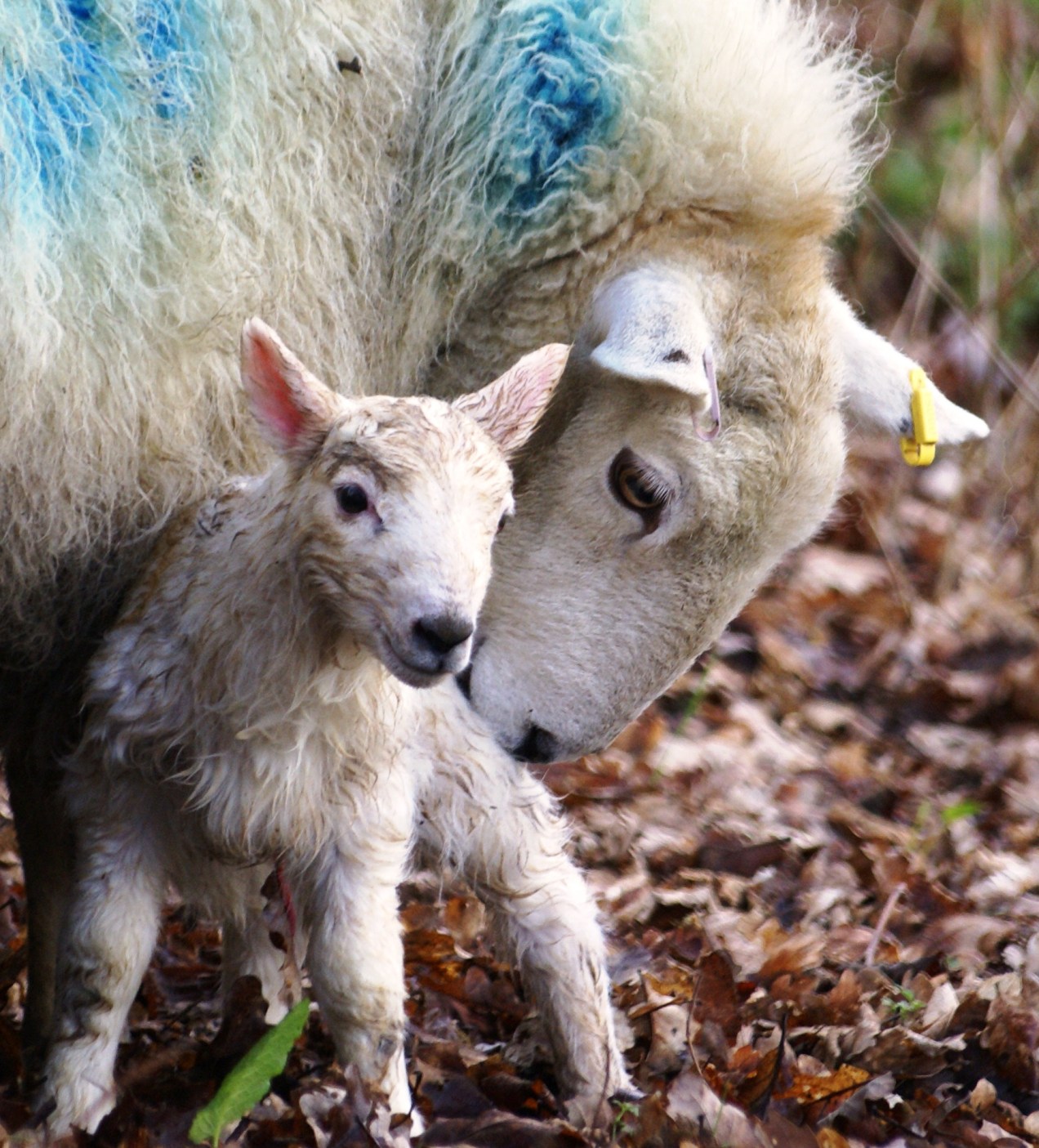
Number Nineteen earlier today with her lambs born a few hours earlier.

Number Nineteen, earlier today and none the worse, with her lambs born a few hours earlier.


Standard
Hill Farming, Sheep

Not a Dying Day

sheltering under the trees

sheltering under the trees

Torrential rain all night — sodden ground but not all that cold — not good lambing weather but ‘not a dying day’ the farmer said as we both looked out across the valley and, for a fleeting moment, the sun came out.

Disgruntled of Mid-Wales -- Horizontal ears -- Aby is not one to hide her emotions

Disgruntled of Mid-Wales — Horizontal ears — Aby is not one to hide her emotions

That was what we needed to hear.

Later in the day the rain abated and someone was baa-ing loudly up by the hedge.  Like humans some of our ewes labour stoically in silence, perhaps with the occasional muted grunt at the very end but some labour vociferously.  Number Twelve is a pretty young ewe, lively and highly strung, she shouts in labour.  Today she shouted that she was at the end of the first stage and I ran out with my binoculars to supervise — that is our arrangement.

They lamb out of doors but not in the laissez-faire, survival-of-the-fitest sense.  We watch and only intervene if they need it and if they need it there seems no problem in them accepting it — I guess it’s all in the timing but our days of chasing the two-headed sheep are hopefully over — that’s a sheep with its own head one end and its lamb’s head sticking out the other.

Ovine obstetrics makes me think of childbirth before the days of modern medicine when more deaths were caused by officious intervention (with dirty hands) than from the complications of birth.  We watch and the more we watch the better we grasp what is normal and what is usual for our individual animals and we do it quietly and from a distance.  Just like humans,  a relaxed and confident mother is the key to a happy outcome.

Here she is, first lamb -- shot from the cannon of her healthy young mother midst  a salvo of baa-ing

Here she is, first lamb — shot from the cannon of her healthy young mother midst a salvo of baas.

Next came our friendliest ewe — I don’t know why she is so tame — she’s never been singled out for special treatment — not bottle fed and never ill.  She took herself off into the hedge, as they do, and silently produced a male lamb.

Friendly Sheep has an immense fleece (descendent of Square Sheep) and has thick wool all over her udders — she is perfectly adapted for life in a testing climate but her hirsutism presents a problem for her lamb — lambs are drawn to the teat by its smell and its heat — insulated teats are hard to find.

In the midst of this hunt while I am considering how to wax a sheep’ udder (ouch!) something else happens — something falls to the ground and rolls down the hill — it is a second lamb and the mother is completely unaware of it.  When it bleats she looks up for a moment then goes back to nosing her first.  Second Lamb shakes his nose free from the membranes with an extravagant gesture and bleats again — no response.

I pick up the lamb and clean its face with my hand then give it to the mother who looks pleasantly surprised and interested and she starts to lick it while I grab Number One Lamb and go hunting the teat.  I plug it in and beat a retreat.

Cleaning Second Lamb

Cleaning Second Lamb

By 10 o’clock at night, Second Lamb is teetering about the hillside, meters from its mum, bleating weakly.  I take it to its mother, ‘Not mine,’ she baas and gives it a gentle butt, then a not so gentle butt.

I try again, ‘Not mine — smell it!’

I do , it smells terrible, like something a dog might roll in which is what it must have done on another roll down the hill..

When my husband gets home from his Domino match, dropped off by a farmer friend he says to the friend, ‘Oh God — you know what’ll happen next — it’ll be in our wet-room.’

‘It is already!’

I tell him that I have prepared a pen in the shed and the friend offers us an adopter — a sort of anti-butting crate.  The next hour is spent slippy-sliding up and down the sodden hillside in the rain with Number One Lamb bleating in a bucket and Friendly Sheep following then panicking and running back up the field to something she couldn’t quite remember.

The other sheep are baaing their conflicting advice.  Eventually our old cade lamb, Aby, comes to the rescue and walks with us, Friendly Sheep was reassured and follows to the pen in the barn where we re-unite her with Second Lamb having warmed and dried it and given it a bottle of colostrum and washed its under the tap, dried it with hay and rubbed it on its big brother so that it smells more-or-less right.

Friendly Sheep settles immediately in the security of the shed, knows she has two lambs though she can’t count and is letting the now vigorous second lamb suckle.

Next morning they are a picture of domestic harmony.

?????????????????????????????


Standard
Communication, Thoughtful

A Mammalist view of Words

There are two sorts of individual: those who need words and those that do not. If you are a writer you are likely to be one of the former — but not necessarily. Nonsense! Everyone needs words!

We have a friend who is a bit different, actually quite a lot different, he has a genetic abnormality that affects his ability to use language — the language part of his brain is absent or switched off.

A dog knows some nouns – his name, ‘dinner’, ‘walkies’, ‘stick’, and some verbs — ‘fetch’, and he understands ‘No!’ My dog understands some phrases – ‘feed the dog’, ‘feed the sheep’ and ‘go to bed.’ But he can’t articulate very clearly and, okay, his grasp of sophisticated language isn’t great.

Our friend’s articulation is better, he has the right equipment but his grasp of language is similar. This is quite a disability – but not that much of a disability. He looks different but is physically robust, as strong as an ox, has good balance and co-ordination, is hard working and eager to please – he will dig or sweep or wield an axe all day. He will walk home, day or night, mile across the fields and is never out of work and rarely short of money. He also has terrific social skills, notwithstanding his appearance and people’s often negative response to him for all the above reasons.

The thing is: he has a very well developed grasp of the non-verbal, knows exactly what is going on, who likes who, who doesn’t and who would stab you in the back – ‘Bad man!’ And he is right. This is another reason folks are wary of him. I’m not sure about the workings of his sense of humour but he loves to laugh, he rejoices in laughter, is attracted to it, infected by it, bathes in good humour when it surrounds him.

His life is very difficult – he loves to be in a social setting but social settings increasingly fear those who are different and finds excuses to exclude them.

It’s a shame I cannot transpose his perception of the world into words for you because, if I could, it would have the emotional intelligence that would stun you and there would be no bull-shit.

Words are very blunt instruments.

This brings me to the thought that set me off on this tack. People that haven’t always lived with animals find it odd: the concept of personality in other species and that is only because we depend so much on language. It means we miss a lot.

Standard