Lyrical

Snapshot in the wind

The fallen leaves are rushing about the field like demented mice, agitated by the wind, running and leaping then taking off in a murmuration, swirling about joyfully then crashed against the window by the heartless wind.

The air roars and tumbles and swats around the house and crowds of raindrops suddenly applaud — driven from different directions, in thral to the wind, their little bodies clapping against the walls, the roof, the glass.

The trees on the horizon rock with uneasy mirth, the firs more nervous than the now bare oaks that stand complacent and let the gale comb through their nakedness. The lone pine thrashes like a wet sail in the hands of a novice, tested by the flailing gale.

http://dailypost.wordpress.com/2013/12/02/weekly-writing-challenge-snapshots/

Standard
Hill Farming

Abi’s Odyssey

What an adventure: today she has led the daughters of the chosen out of peril,  defied a mighty king, travelled the length of the known world, faced alien hordes, unperturbed, and tasted the fruits of a promised land and it’s not even lunchtime.

Everything is relative.

Seven years ago (a biblical period) I probably wouldn’t even have noticed, I wouldn’t have spotted those white dots on the farthest hill, wouldn’t have wondered about the gender of the dots.  Wouldn’t have rushed up the valley, binoculars in hand.

But as I approach our boundary I need no binoculars to see that our neighbour’s tenant has loosed a ram and 20 breeding ewes into the adjacent field; the one with the dodgy fence posts that falter and play dead when challenged.  Through that very fence his randy tup is sniffing at our precocious theave lamb (see Raddle-Dazzle); she makes me think of Anne Boleyn, she is running daintily up and down by the fence baa-ing prettily but surprisingly loudly and each time as she turns, she stamps her little feet, the old king, on the far side of the fence is transfixed — enchanted.  Meanwhile his ladies gather around his number-one-wife, the dominant ewe and whisper, looking accusingly at that Boleyn girl ( she has a streak of mud on her back, they are questioning her virginity — well, perhaps not)).

?????????????????????????????

I run back to the house. opening and shutting various gates on the way and fetch my magic bucket which has mysteriously been tampered with; it has been used for chain-saw oil, which smells bad; its power lies in its mystical maltiness; I chant appropriate expletives as I clean it and refresh its ewe-nut rattle and scent.  A moment later I have my sergeant at arms, my witch’s peculiar, my familiar; she hurtles to my call, not a swooping, weaving bat, nor an owl, blinking in the light of day, but a clomping old ewe who is trained to my bidding and I to hers, we set off, Abi and I and the dog, armour glinting in the morning light.

Odyssey

Ten minutes later and two of us breathing heavily, we have reached the farthest outpost of our kingdom, it has not yet laid down under the weight of conjugal bliss, I rattle my magic bucket, Anne Boleyn tosses a dismissive glance over her shoulder but her maids come and have a sniff and when the sergeant and I turn and walk away they follow.  Anne looks at us, then at the king, then back at us, she is deserted by all her people…  She fears nothing more than being alone, she is, after all, a sheep.  It’s too much, she turns away from the king and runs down the field and we all walk steadily back towards the farmstead.

As we draw farther away the foolish virgins look back, I know that with every step we take the pull of the king is less so we keep walking but then there is a scream on the opposite bank, a hollering and the unmistakable call of a hunting horn (really — not just another escaped metaphor),  there is baying of hounds directly ahead.  My foolish virgins stop dead, so does the sergeant at arms, they start to turn, I shake the bucket, the sergeant advances towards it, Good Old Abi.  Our dog who has been following aimlessly sniffing for rabbits, suddenly hears the threat and runs to take up a position at the head of our column, as he overtakes the sheep he turns them and provides a little push and they again follow us.

We stomp on confidently; they follow nervously.  I close the last gate behind them as the baying abates.  Typical!   We haven’t heard hounds for a year, hunting is illegal, and they don’t exist but they pass through the cutting by our gate just as we are moving timid sheep.

Standard
Fiction

A quiet friend

They lie by the fire with the tips of their middle fingers just touching, their thumbs pointing out into the room and the little fingers reaching towards the heat; the gloves are grey, hand knitted in a plain stitch without pattern.  Sure enough, Norman, their owner, is sitting in his corner, motionless, immaculate, his grey hair now corrected from any dishevelment caused by the wind outside, his parting pin-point accurate, his comb returned to the top pocket of his grey tweed jacket, his overcoat hanging from the only hanger on the hooks by the door, he has brushed the single speck from its shoulder with his then still-gloved hand.

His back is straight and rests against the upholstered bench that runs around the wall of the front bar, his legs are stretched out in front of him, beige trouser-creases crossing below the knee, polished brown shoes shining in the fairy light from the bar.  The evening paper is neatly folded on the shelf beneath the table; he does not touch it.  He looks out into the room without expression, a glass of orange squash, obtained without negotiation and paid for with exactly the right money, sits untouched on the table in front of him; it will remain there until just before he leaves when he will drink it down in one and return the empty glass to the bar.  He will weave unseen through the people and leave but we will notice that his gloves are gone.

Norman has a story; everyone has a story.  The more controlled a man’s world is – the more bizarre is the eruption when it comes and come it always does.

I will not tell you Norman’s story for the one I have may not be true and anyway you will probably have heard it before.

http://dailypost.wordpress.com/catergory/writing-challenges/

Link
Hill Farming

Raddle-dazzle

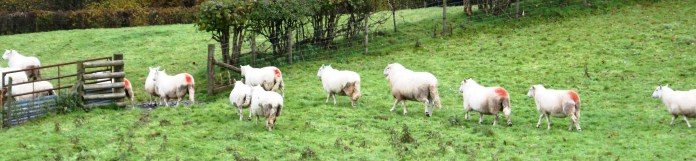
Autumn colours are appearing and our sheep are starting to show russet coloured bottoms; unlike the flurries of blowing leaves or the spiceyness in the damp air, this is not a natural phenomenom — not entirely.
?????????????????????????????

Our neighbour, out of a sense of humour or aesthetics, marked the ram that he lent to serve our ewes with rustic mellow autumnal paste, the colour of chestnuts and dying bracken.  He, the ram that is, is painted with a thick wadge of this sticky raddle, between his front legs, hidden under his deep masculine chest so that as he discretely does his job, the ewes turn brown and a flurry of them follow him and swirl around him like a gust of fallen leaves.
????????

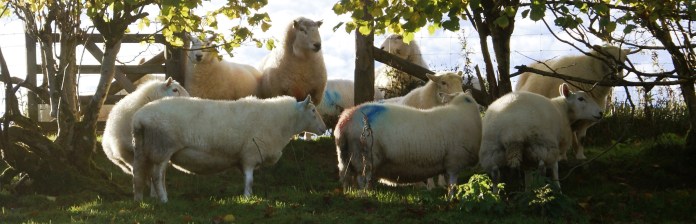
Tupping is not what I had expected, with my human prejudices, when we started farming.  We have only one ram, there is no fighting, no rut, no competition for the ewes.  The ewes who live together all year, who are related and most of whom were born here are very welcoming to the ram each year.  Above, you can see them shepherding him around the fields politely showing him the shelter and the stream.

In turn, and nature is very clever with this, they introduce themselves, as each ovulates and comes into season.  For a few hours the chosen ewe will follow the ram closely, nuzzling his neck affectionately.  He sniffs the air and checks her out, mounting her tentatively at just the right moment.

?????????????????????????????

Meanwhile there may be one or two other ewes about to be ready, they form a guard of honour, bride’s maids, following closely, waiting patiently; something about the chosen ewe, probably her scent, makes the others hold back.

Soon after she has been marked she retreats a little although she may follow him for the rest of the day while he gets on with the job in his gentle, quite respectful way.

Next day the ewe is back to normal grazing with her other red-bottomed sisters.  Once all are red, some by then only very pale pink, the ram will settle down too.  He will graze with the ewes and still be larger and handsome but nothing in their behaviour will betray his presence.

But we have a problem!

?????????????????????????????

One of our pretty theave lambs (only 6 months old, precocious/foolish virgin) has developed a far-away look in her eyes and the ram is sniffing ominously at the gate of her field.  She must be moved out of his amazing nasal range.  But she has been fed on grass all summer, she does not follow my bucket and has no experience of the treats within.

I need help: come on Abi!

?????????????????????????????

Abi is our secret weapon, our dear old ewe who started life as an orphan in our shower-room and taught me nearly everything I know about sheep; she is my lieutenant or perhaps more of a sergeant.  She likes to walk around the farm with us, butts the dog for pride of place and the other sheep will follow her.

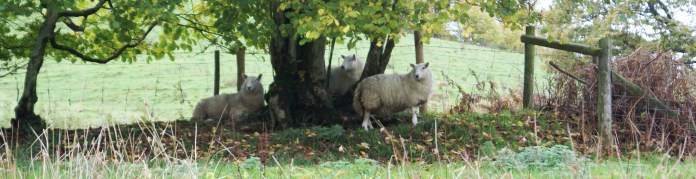
Sure enough, she comes running when I call and, having shut the breeding herd up in one of their fields she rapidly helps me lead the three foolish virgins across the other field, through the woods and up onto the hill, half a mile away from danger, on the other side of the trees.  Here they can sit under the hedge and wonder what it was that made them feel suddenly so strange.
?????????????????????????????

Standard
Uncategorized

Remember

Today is Remembrance  Sunday and this year, thanks to the internet, we know more of the detail and scale of our personal loss, repeated in almost every family in Europe and the Commonwealth.

We remember George Stewart who died at Passchendael in 1917.

We remember Frederick  McWicker, from Bacup, who died of his wounds on 12th November 1917, fighting in the Egyptian theatre of war with the 5th battalion of the Royal Welsh Fusiliers.  He was 24.

We remember his brother, Walter McWicker, my husband’s grandfather, who died of his wounds on 24th February 1918 in Flanders, fighting with the East Lancashire Regiment.  He was 39, a slipper-maker with three children, conscripted late into the war because of deafness and he died when he failed to heed the bugle calling a retreat.

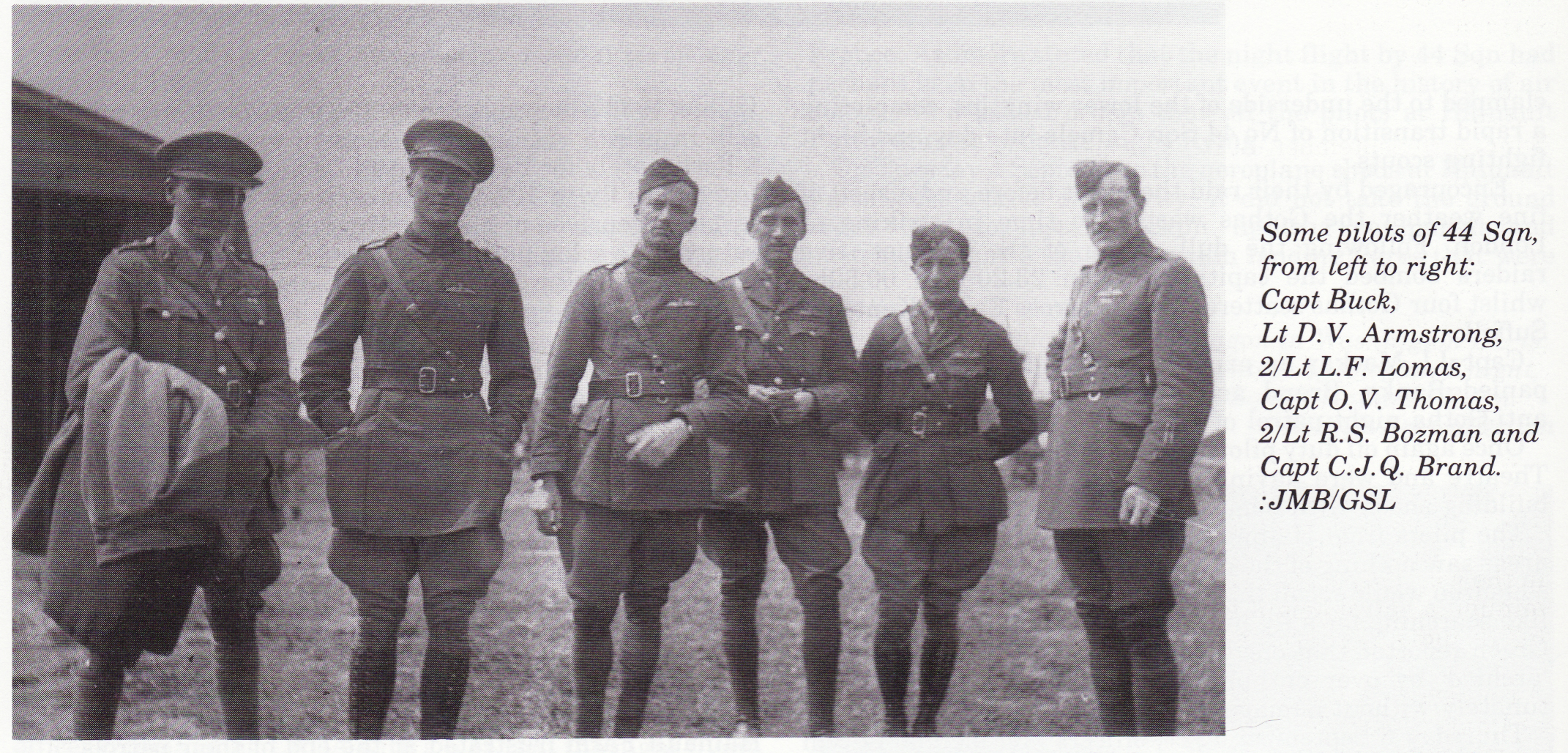
We remember Geoffrey Sebastian Buck M.C., D.F.C., who died in action with the RAF in France on 3rd September 1918, aged 21. His plane which had been badly shot up while flying over the lines, disintegrated on landing.

buck

We remember his uncle, Cyril Bernard Wilson Buck, priest and army chaplain, aged 39 when he died, tirelessly tending the wounded under fire in France on 29th September 1918 for which he was awarded a posthumous military cross.

Standard
Hill Farming, Uncategorized

Autumn

Pale morning sunlight casts long shadows and the gateposts steam in the horizontal rays.  The grass fluoresces greedily gathering what energy it can, drawing in moisture from the wet fields which creek and seep.

?????????????????????????????The oak trees on the hill, always last to shed their leaves, are just beginning to turn russet while the scatty larch trees are aflame and the phlegmatic hazel has already loosed its leaves to drift aimlessly and lie on paths with the last of the rowan berries.

SONY DSC

Autumn is the beginning of our year, the sheep-farming year.  Our ewes are in the peak of their condition, replenished by summer grass of which, this year, there is plenty left to flush them as they go  to the tup.  They are impatient, occasionally butting each other as the younger ones readjust the pecking order in anticipation of something…  The neighbour’s ram will arrive tomorrow.

?????????????????????????????Look into their eyes and tell me they are not intelligent and excited!

Standard
Hill Farming

Where do you start?

We have been heeding the Welsh Assembly Government’s injunction to farmers to renovate traditional farm buildings.

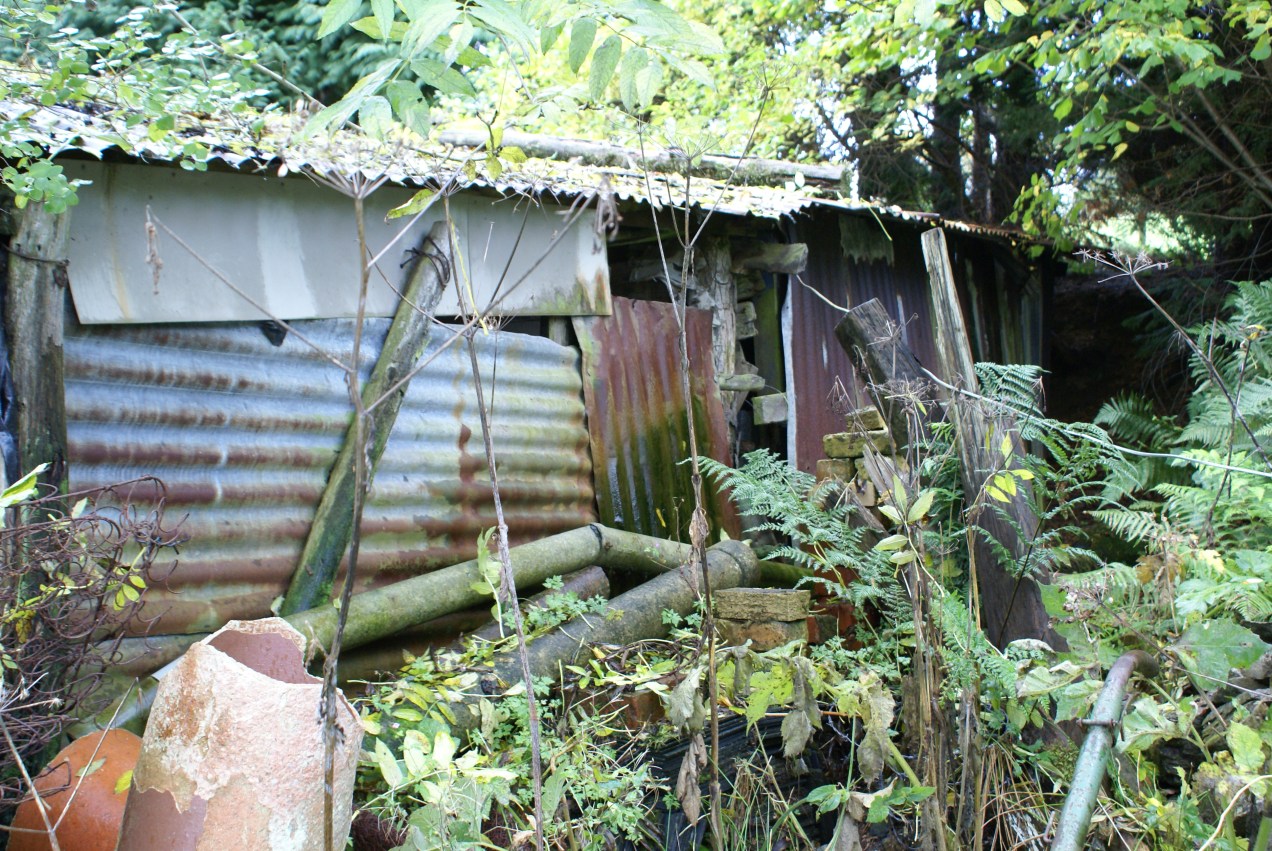
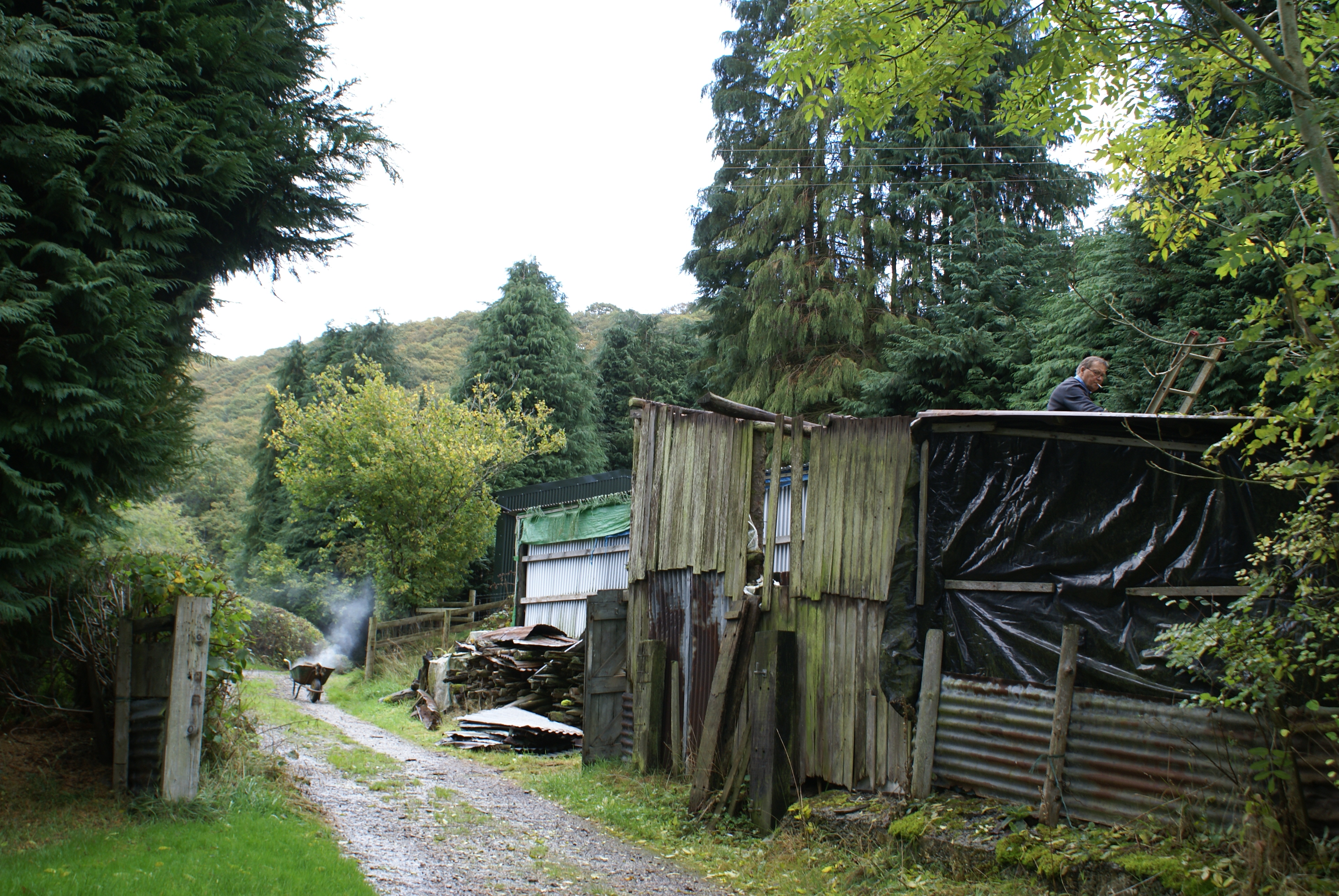
Traditionally a hill farmer with twelve children and as many useful acres built with what was available: stone from the river bed, oak and hazel from the woods and rushes or bracken to thatch, all lashed down with honeysuckle twine or tiled with flat pieces of the local flat stone (almost slate).  In the last 100 years the philosophy hasn’t changed but available materials have.  Here is our traditional barn.

SONY DSC

Welsh nouns have gender and she, the barn, is made of scavenged telegraph poles, tree trunks, branches, corrugated iron, galvanized sheets, draining boards, old doors (wooden,fridge and car), fencing panels and bits of garden shed (or the old privy), tarpaulins, a First World War great coat and carpet (not on the floor, of course, but stapled into the walls) with sacks made of plastic, hessian and paper and all held together with wire and baler twine of plastic and hemp.

SONY DSCSONY DSC

It is a basic timber frame construction, clad inside and out with the aforementioned materials and the cavity filled with balls of twine, sheep’s wool, oily rags, empty jam-jars, fag packets (that’s cigarettes if you are American) and a mummified rat.

The whole thing is reinforced by forty years of incorporated tree growth and drained by various burrows.

At the rear is a concrete plinth presumably for the generator that produced the electricity before 1964 and was protected by a steel door with a rusty padlock still hanging open in the hasp and, believe it or not, a brass key, hanging nearby on a nail and still operating the smooth action of the lock without so much as a squirt of penetrating oil; the brand new padlock we put on the field gate last year had seized by November.

SONY DSCWe discovered all this as we lovingly unpicked it and sorted what we found – into metal scrap (£!!!), firewood for next winter and burn now!  Even  though latterly it had been a health and safety nightmare, demolishing it was a sacrilege – an insult to those who built this monument to ingenuity, inspired in poverty and an antidote to materialism.

Standard
Local History, Uncategorized

Man Eats Dog

I have been writing the biography of a man who lived in Wales through the depression of the 1930s; he was a famous international amateur footballer but also a notorious poacher and wit; I have been reading endless accounts of long forgotten football matches and interviewing his large family and friends, hearing their stories and cobbling together some sort of narrative.  The interesting thing is how it demonstrates the nature of story telling.

When someone repeats someone else’s oft-repeated anecdote it is sometimes difficult to be sure what the point of the tale is.  The chap I was writing about told his children many times about going to help a farmer with the harvest and noticing that the farmer’s dog was nowhere to be seen.  Later for lunch they had a stew of unusual white meat that the original teller of the tale remained convinced was the dog.

Man eats dog — what was the point.  He had repeated the story throughout his life — it had made a big impression on him him.

Was he disgusted?  What did he say it was like?   Quite tasty.

Meanwhile I was struggling with my hero’s poaching, not just the stealing but the ecology, as locally long-extinct species appeared in the family pot and fish roes were boiled up, in the breeding season, for bait.

Then I remembered the poor farmer’s wife with all those hungry helpers come to take in the harvest with no payment in prospect apart from one decent meal and my hero’s narrative reached me over the years.

Image

H.B. ‘Gurra’ Mills in about 1923 — reproduced thanks to his family.

You can access his full biography on the ‘Published Work’ page of this website.

Standard
Uncategorized

Back From The Edge

We’ve been to Ireland looking for ancestors and got more than we bargained for; hot in pursuit of deceased episcopalian ministers, we ran to earth an Andrew Buck.  He was the first of a long line of ordained members of the established church, not the anti-establishment hero I had hoped for.  Nevertheless, in 1742 he had entered Trinity College, Dublin, as a sizar (subsidized student of exceptional ability but humble means).  He became a doctor of divinity but never seems to have had a parish though we found reference to him as being “of the Hibernian Academy”.  This was not a euphemism for University of Life, it still exists.

The modern man at the, now Royal, Hibernian Academy was on holiday; perhaps he was chasing his own ancestors in Spain so, assuming that my ancestor had died, we made haste to search graveyards.

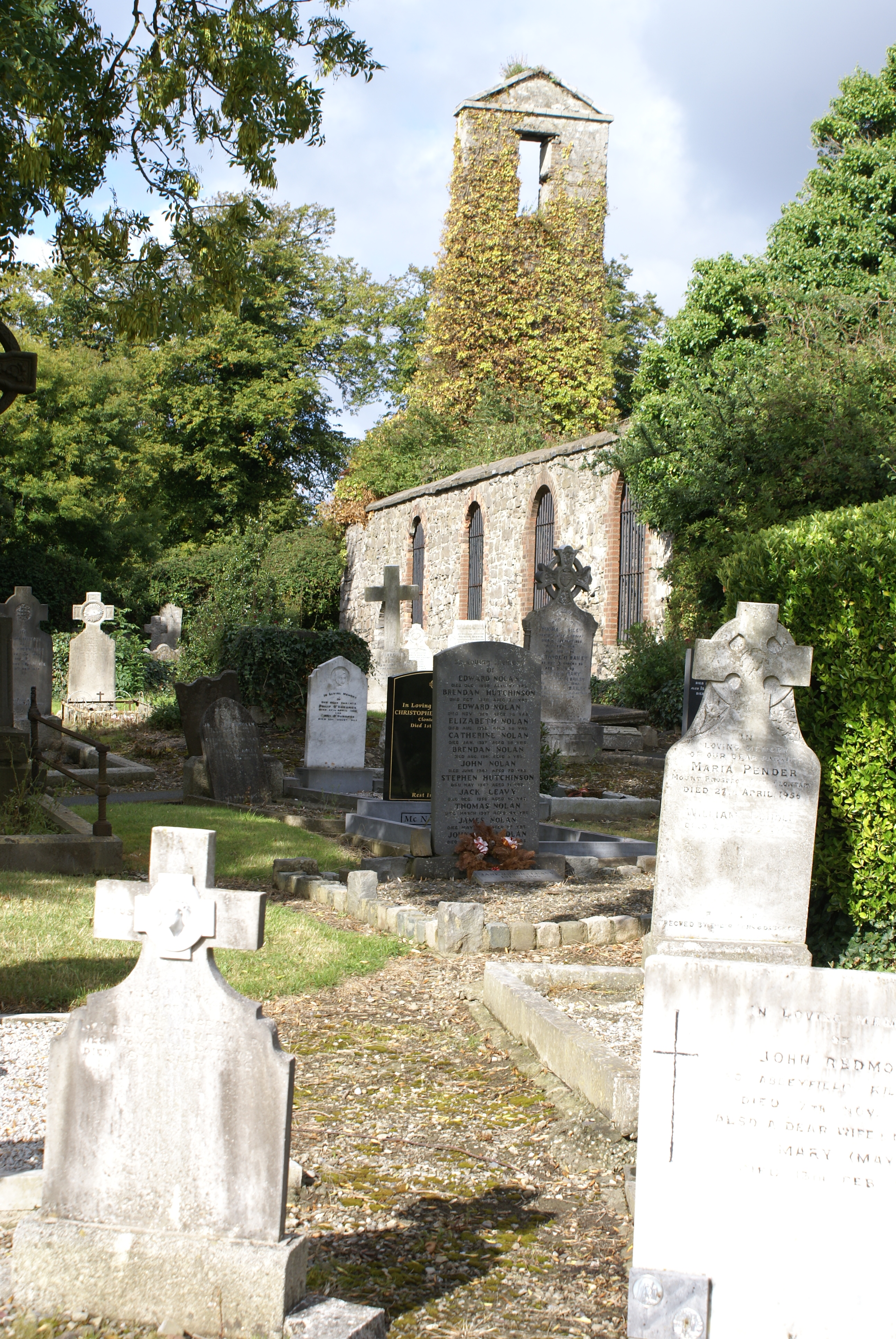
Alan (long suffering spouse/driver/ambulant thesaurus/spare pair of eyes and rememberer of all things important – well nearly all) was triumphant: finding the shattered remains of the gravestone of my Great (x5) Uncle Jonathan in the ruined churchyard in Clontarf.

Ruins of Grt (x5) Grandpa's church, Clontarf

Ruins of Grt (x5) Grandpa’s church, Clontarf

Crown adorns St John's new church, Clonfarf

Crown adorns St John’s new church, Clonfarf

Finding the graveyard had been the hardest part: the first church, of the right name was of the wrong denomination and in the midst of a funeral for which, on a sunny day on holiday, we were inappropriately dressed; we did not stay for tea.  The second church had its roof off and would not let us in.  Anyway, where the graves should have been there were tennis courts with attractive people playing ball.  This was an inter-regnum; the new LADY vicar was to be installed with the new roof and meanwhile, a sinner told us, our relative would be down the road in the ruined churchyard.  There, to be sure, he was, with his wife, my Auntie Anne.

Great(x5)Uncle Jonathan reminds us of our mortality

Great(x5)Uncle Jonathan reminds us of our mortality

We were just as lucky in Limerick where we hoped to track down Andrew’s humble origins; the lady at the Cathedral (Church of Ireland) is still looking but not before remembering the name Jonathan Buck (probable grandfather of the one Alan found in Clontarf).  She had looked him up for an exhibition about silversmiths in Limerick that had recently finished at the Hunt Museum, just down the road.

The young man at the Hunt was delighted; there had been a book of the exhibition – A Celebration of Limerick Silver; it had not sold well; they had reduced it from E40 to E10; he remembered because he had bought loads to give as impressive Christmas presents but there was one left!

Celebrating Limerick silver with Guinness and sandwiches we discovered (shock/horror) the Dutch connection.

We read that, just maybe, the oldest Buck of them all, one George Bockendoght, a victim of abbreviation in the mid 1600’s, was probably imported from the low countries by the Earl of Orrery.  He came to boost the economy after Oliver Cromwell had just personally expelled, one way or another, the skilled Catholic Irish and the Royalist English — it was a bloody affair and to top it all, and to reassure us that nothing has really changed, they had a currency crisis and needed more coins struck!

There we are!  Not descended from a heroic peasant from the wild and beautiful west coast but a new man, arriving in the wake of genocide to institute quantitative easing.

Wild West Coast

Wild West Coast

Standard
Uncategorized

Market Day

SONY DSC

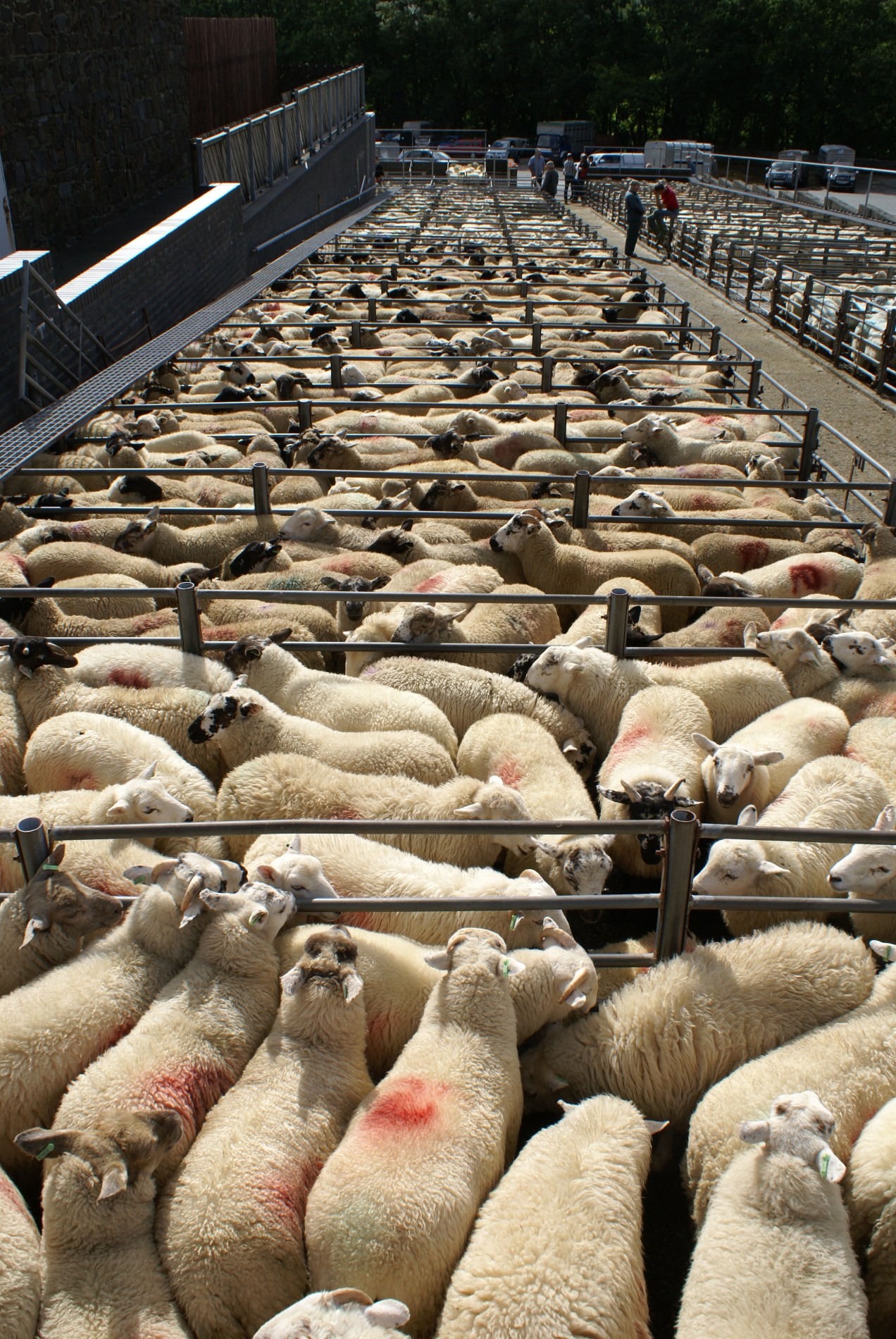
Dolgellau is a small livestock market, yesterday full of magnificent lambs, nearly mature now, trimmed and tidy, clothed in innocence and looking to their shepherd’s face for clues and sniffing the air, which was relaxed.  These were being sold as store-lambs, to go on to other farms, not for slaughter.  The owners were easy, joking, ready to chat.  Cull ewe sales are a different matter, the sheep are left and the farmers have urgent matters to attend to elsewhere, they don’t hang around to see old ewes sold, those they have lambed and pulled out of bogs in the middle of winter or dug out of snow drifts.

Yesterday at Dolgellau, farmers perched on the pen rails, in the autumn sun, and chewed the cud.  They looked at lambs smaller than their own and bemoaned the future for those farming on the edge, on the high, rugged land that you can see from the market, where the mountain pass rises by Cader Idris.

Old men remember the winter of ’47 or riding from Llanbrinmair  to Aberystwyth over the moors without having to open a gate and the sheep court at Dylife where they sorted out the stray sheep once a year.

Young men know that the openness of the country still prevents them controlling their stock as they would like; one cautious man, mindful of recent late springs decided to lamb later, as they used to, only to find that his neighbour’s tup had already serviced half  his ewes!

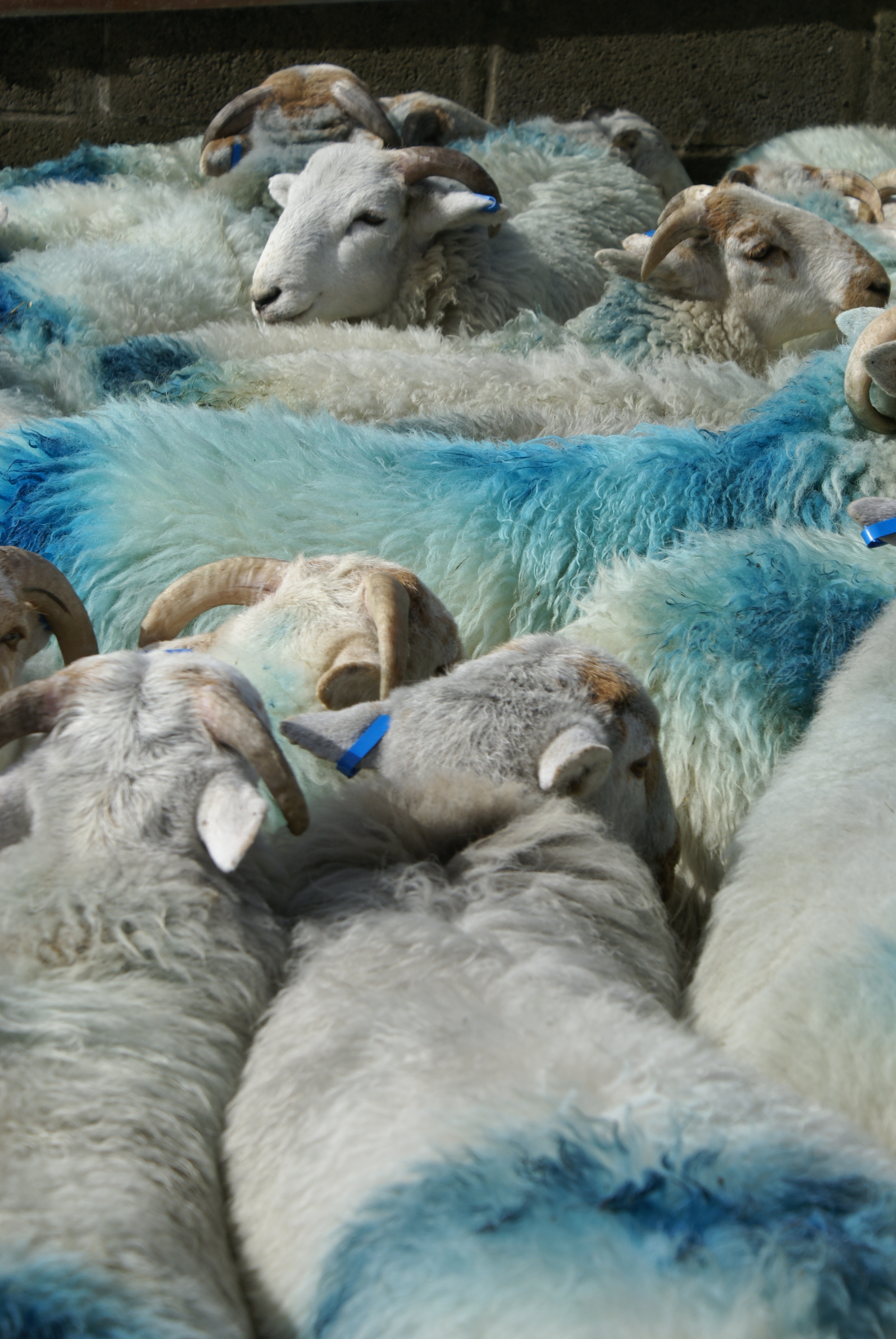
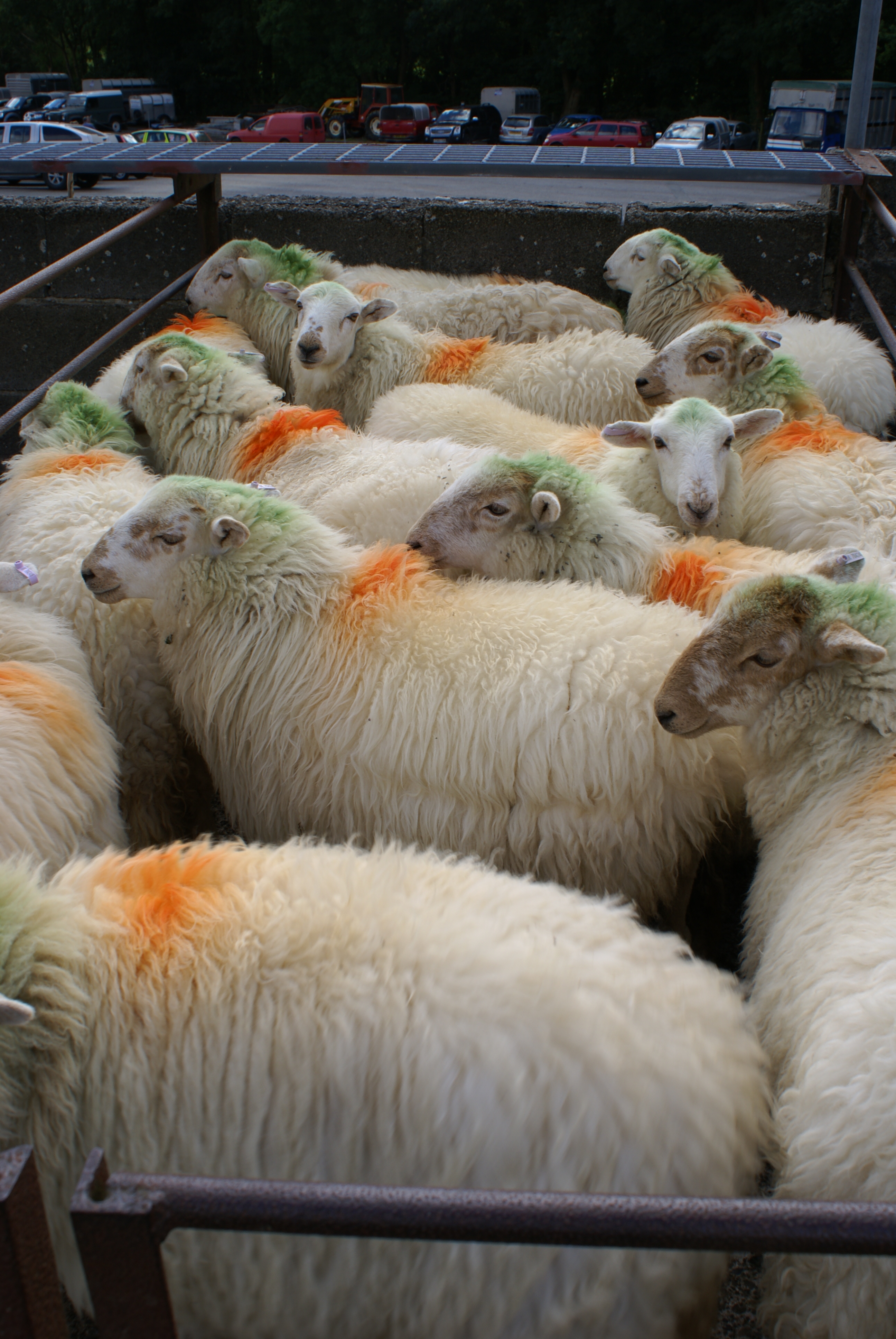
Bold marking helps muster sheep in mountainous ground where the hardy beasts jump stone-walls, hence the colourful pens of sheep.

SONY DSCSONY DSCSONY DSC

Yesterday there were also people showing their pedigree Improved Welsh Mountain  sheep.  Prior to this I had harboured hopes of one day producing a breeding ram but I realise this is folly.  These creatures have huge curled horns; the first and only year that we used a tup with horns the ram-lambs he produced, although as lively as you like, kept hooking themselves in the fences and one died.  Now we always use a hornless male to father our lambs and although not always hornless the offspring have poor horns,certainly not suitable for hanging on fences and not show-horns!

The sight of a large ram walking to heel, on a lead is incongruous, like some strange dog, one that occasionally has a flash of recall and lowers its head, arches its back and kicks out its back legs, like a bison, before turning its head graciously to the camera.  Breeders are flushed with pride but avoid any undue shows of emotion, this is, after all, a livestock market.

SONY DSC

It is a proper manly place, not the sort of establishment where buyers are squeamish about testicles or undocked tails.  In this more rugged terrain, there are enough challenges for young animals without adding to their stress by castrating or introducing infection and anyway, I thought testosterone built up muscle and isn’t that what its all about?

That brings me to lunch, £5 for a massive bowl of casseroled lamb’s liver and bacon with baked vegetables and mashed potatoes, eaten from the bowl with a knife and fork and fit to serve to anyone, anywhere.  And pies and cakes and home-made fruit flans with cream to die for…  But that’s not a problem for the men who still run up these steep hills tending their flocks, who carry sacks of feed,three at a time, and lug fully grown ewes about as if they are tired children and walk rams about on leads.

Standard