Art, Family History

Is there an old master in your loft?

Have I found an old masterpiece in my loft?

Not quite, but just as exciting.
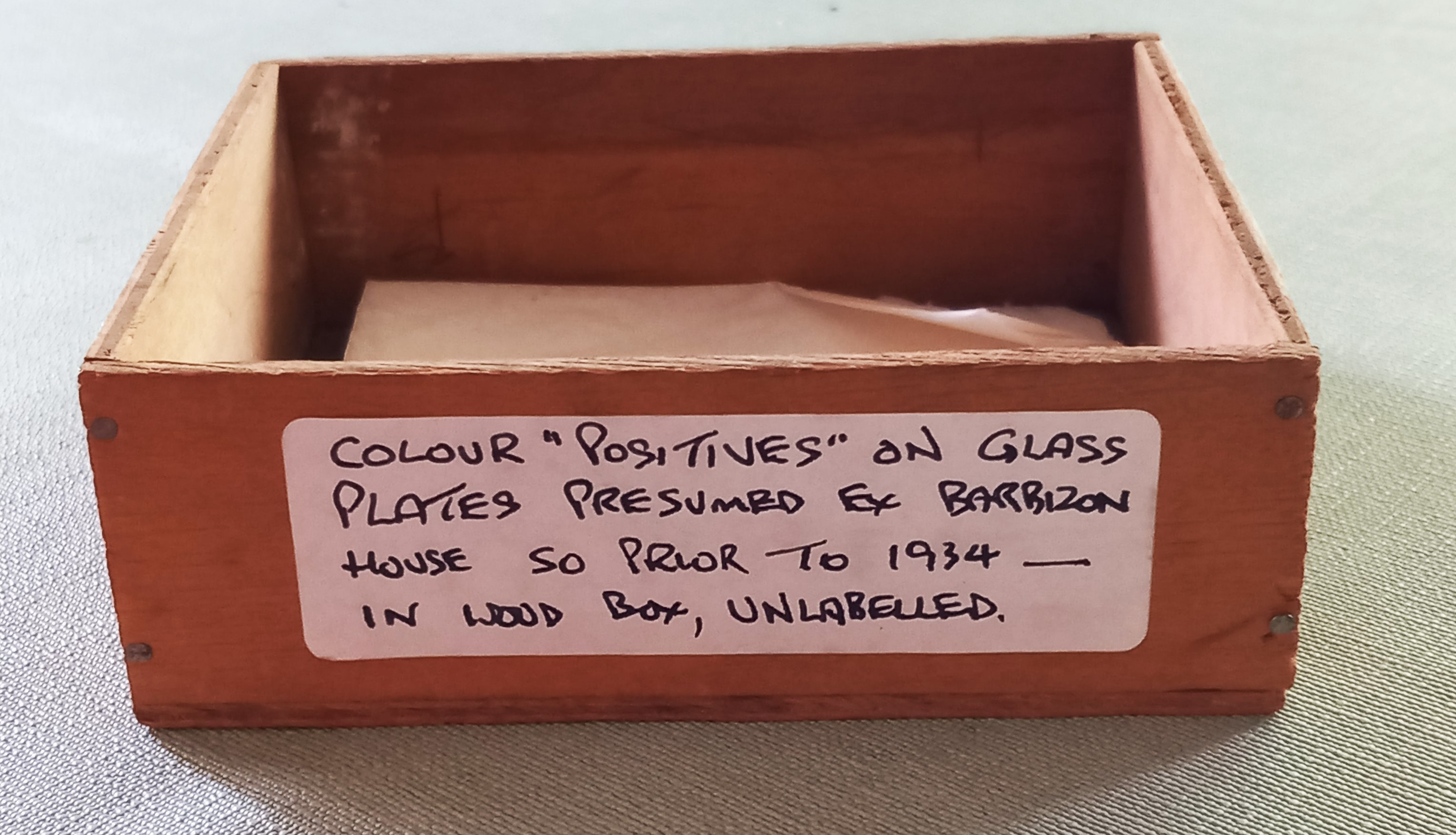
I decided to sort out my grandfather’s bureau which I’d been meaning to do since my father died in 1992 and I found this little box which Dad had meticulously labelled when going through the same process after his own father’s death in the early 70’s. It contained colour photo slides on glass. I held them to the light but couldn’t make out the subjects but they definitely weren’t holiday snaps. Was I to pack them back in the draw and leave them another 50 years and a new generation?

Curiosity got the better of me! I managed to get them printed.
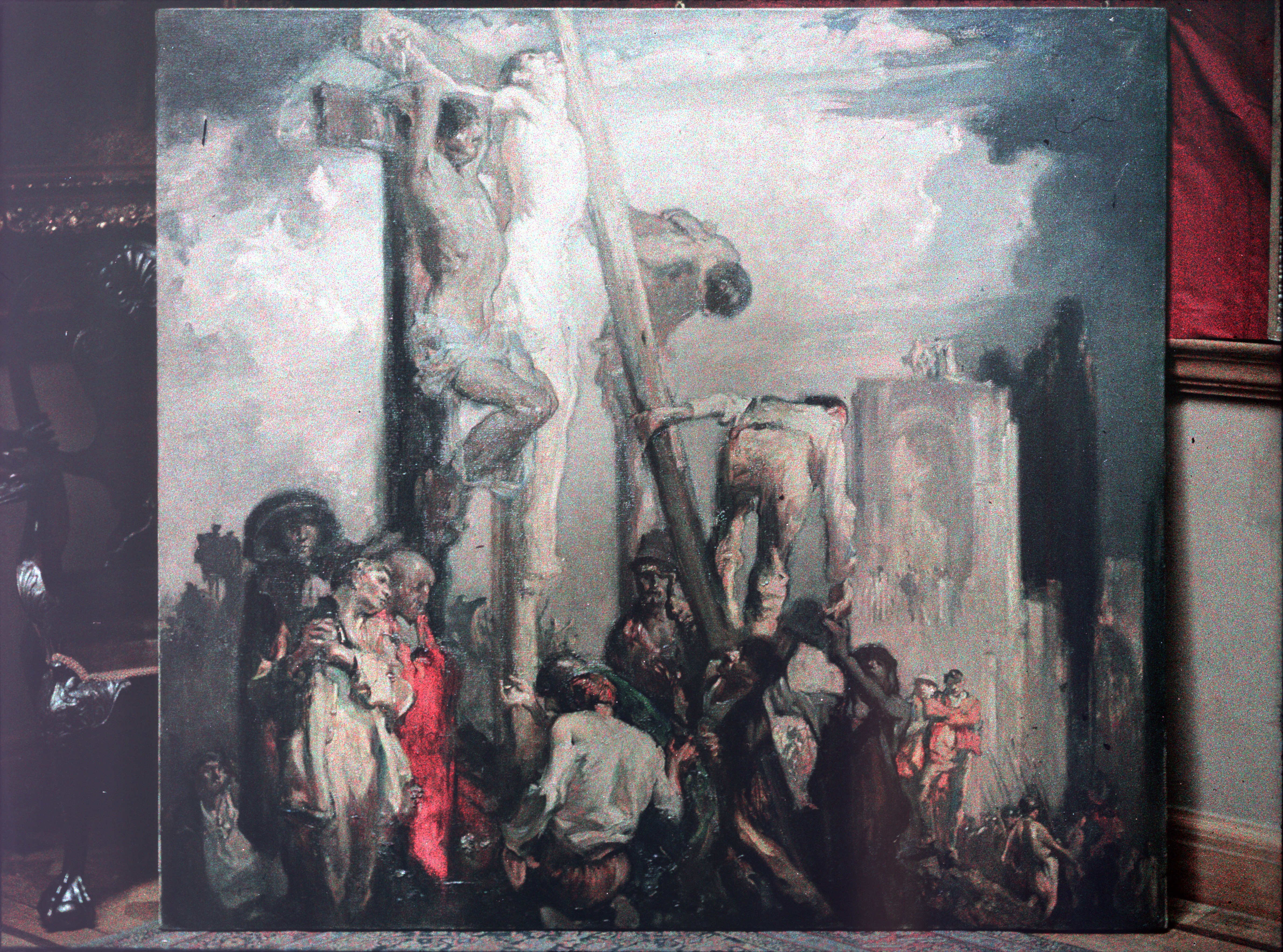
Firstly — a harrowing picture of the crucifixion, clearly a large oil painting, unframed and leaning against a chair, by an artist I recognised. My grandfather, as a young man had been involved in representing and selling this man’s work before 1934 when he worked with his wife’s cousin David Croal Thomson, at the London gallery, Barbizon House. It was during the depression and eventually went bust. The artist was Sir Frank Brangwyn (1867-1956) who I have heard described as the Welsh National Artist. The actual painting survives and I have tracked it down today to Glasgow Life Museum, but not precisely enough for us to be able to visit it.
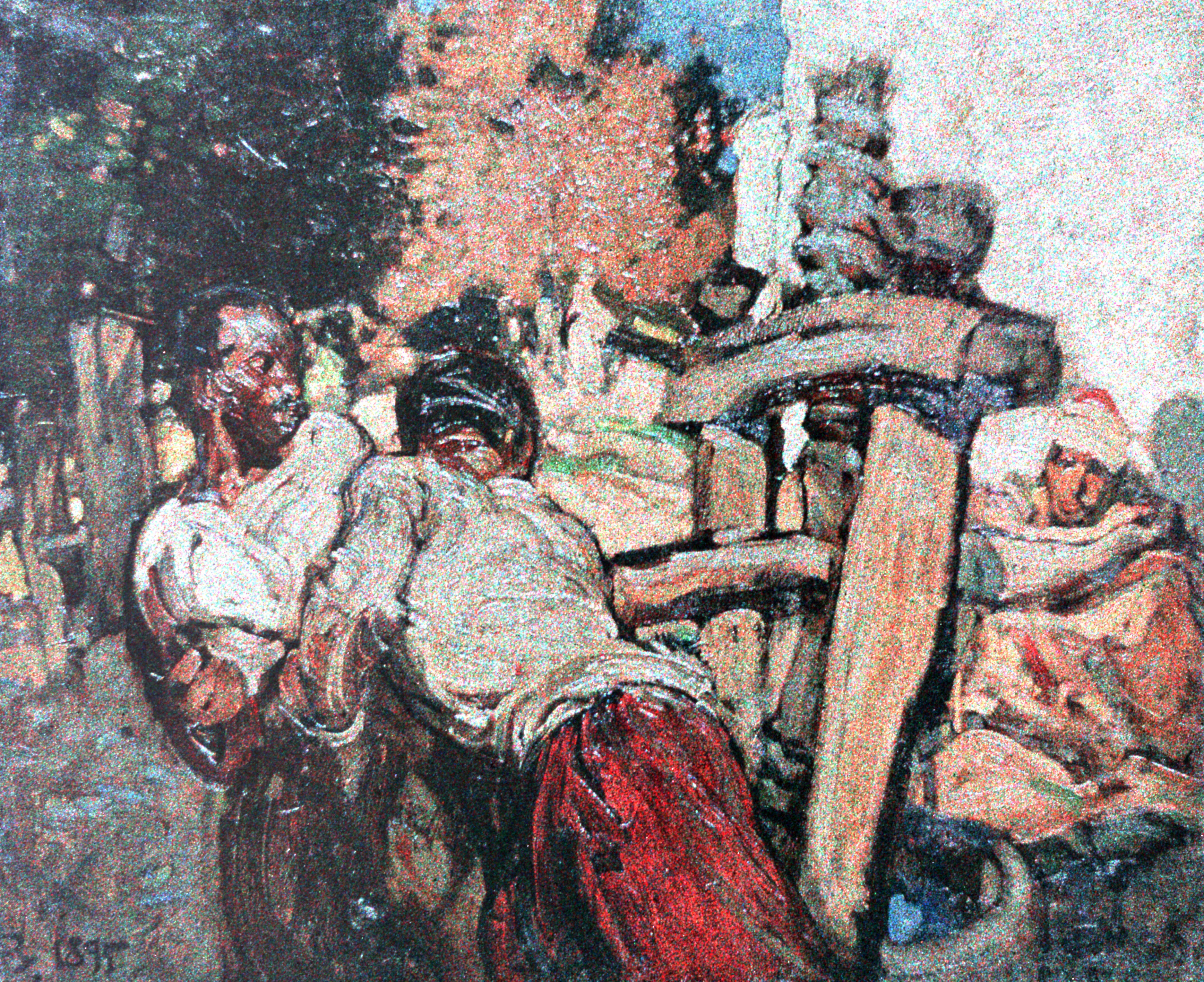
As a young man Brangwyn travelled widely, sponsored by a shipowner who allowed him to go on a freighter to Istanbul. Fascinated by the colour and diversity of the scenes he saw, he continued to paint around the world, visiting Zanzibar, South Africa, Egypt, Turkey and Morocco. This scene from another painting photographed by my grandfather, A.F. Buck, shows the pressing of maybe olives in North Africa.
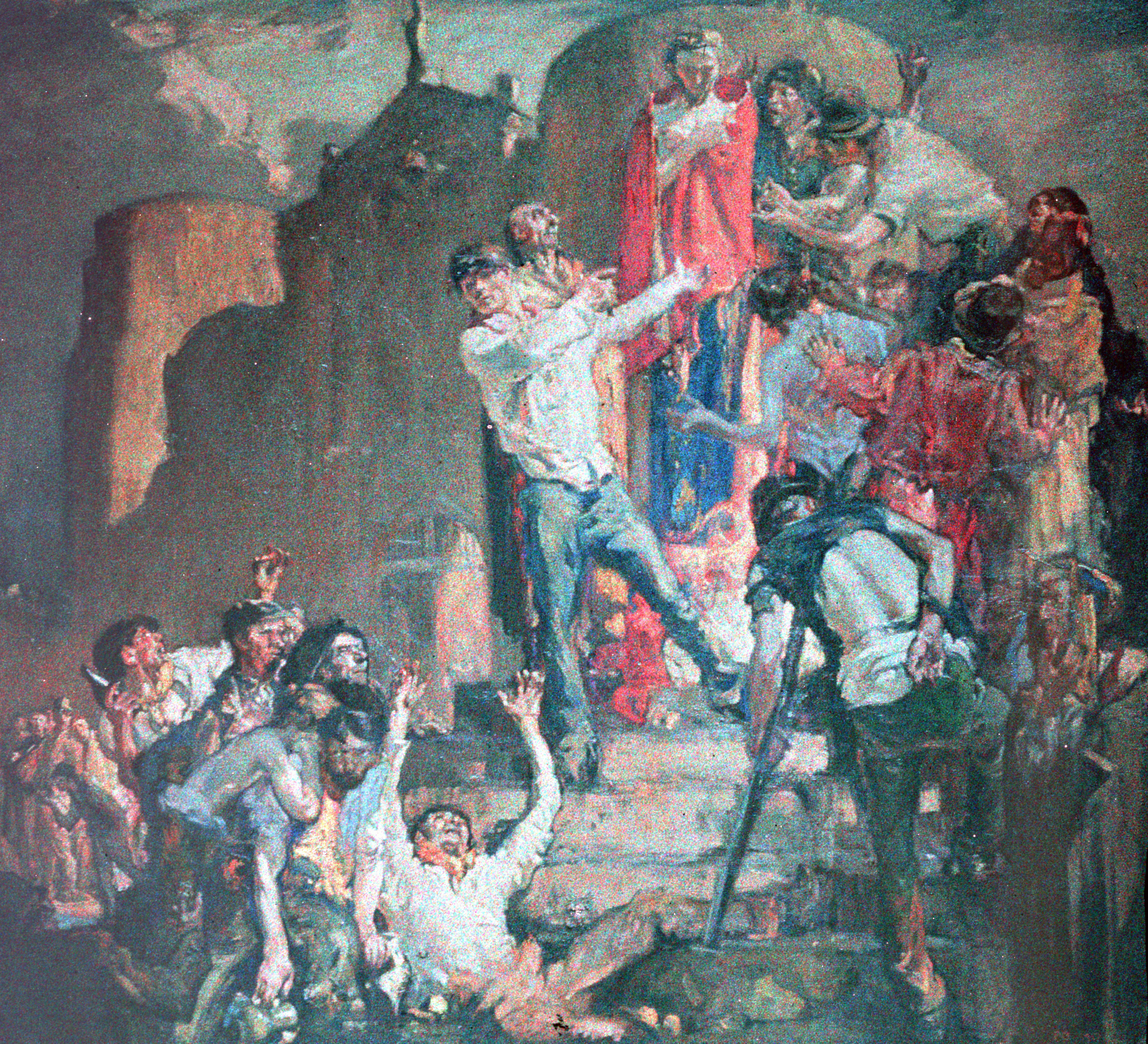
Above is another harrowing religious scene; rather melodramatic, is this to do with Jesus healing, the chap with the crutch is in etchings I have seen of Lazarus. I don’t know where this one has ended up. Does anyone recognise it? The costume reminds me of someone.
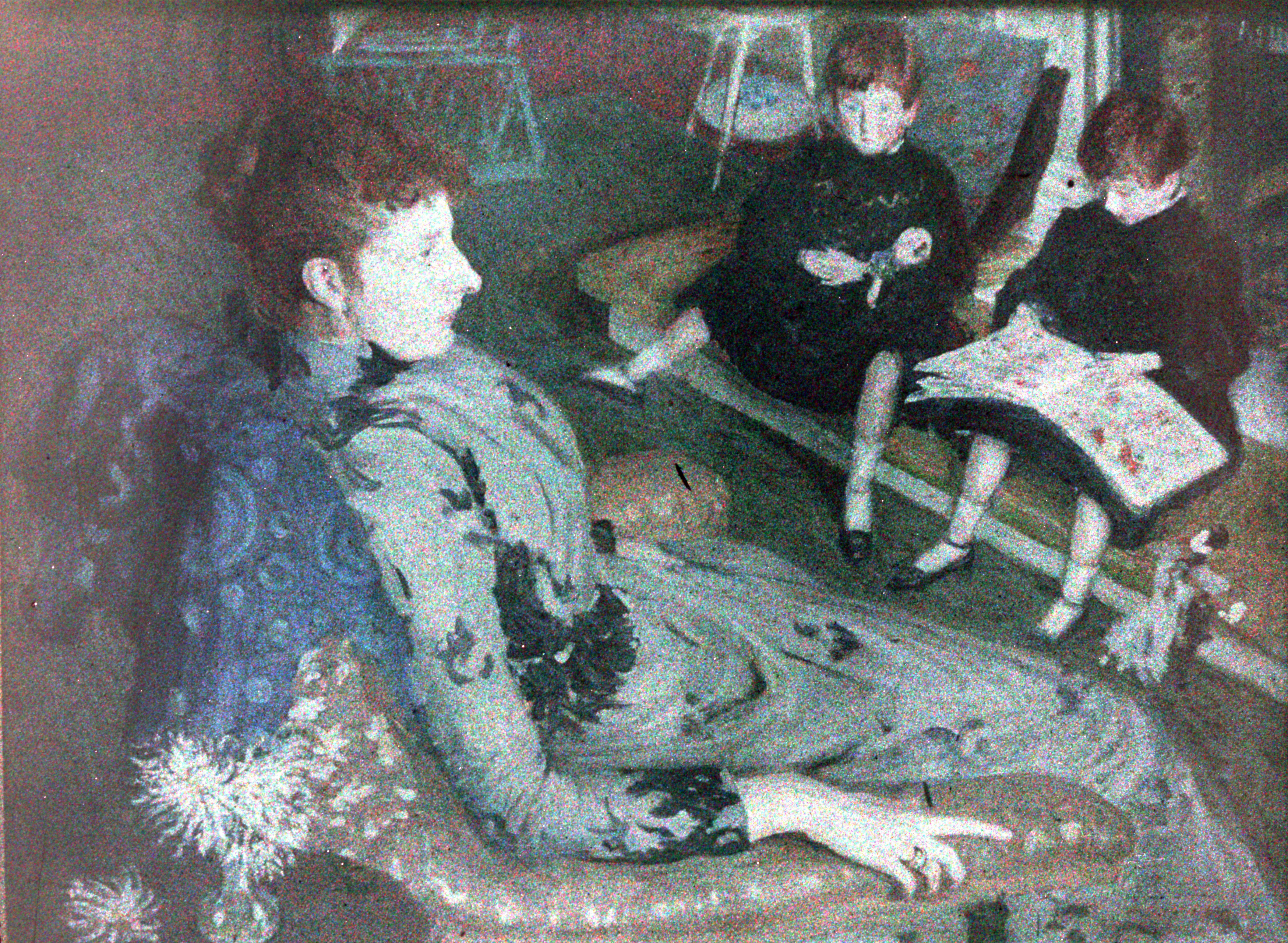
Lastly, there are several shots of this mysterious and uncomfortable looking lady with her two children. I cannot work out who she is but I know that my Grandfather’s cousin by marriage, David Croal Thomson was quite keen on having his children painted by the famous artists of the era. I remember a particularly beautiful painting (long since sold) of Evelyn in a bluebell wood by Whistler, very “Pre-Raphaelite” with the family’s red hair! Could this be DCT’s wife and 2 of the children? Anyway she doesn’t look too happy about it, I’m sure her corset was killing her — I doubt she liked the image. Perhaps it was consigned to an attic somewhere!
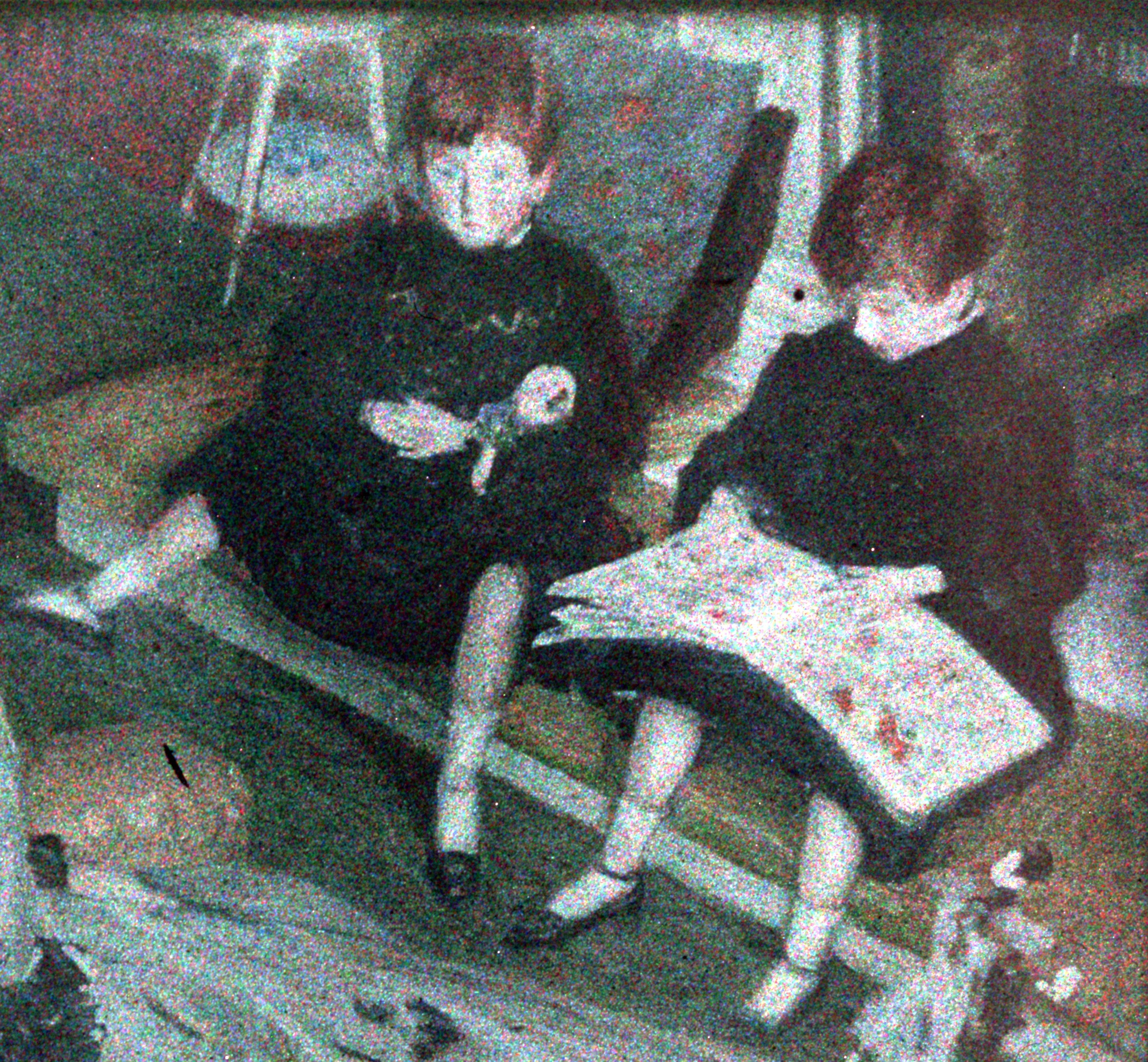
I think they could be either gender, if you find them in your attic: the painting is by Sir Frank Brangwyn!

Standard
Family History

The Betjemann Connection

The weather is bad and I have been browsing in my great-granny, Isabella’s photo album, an object lesson in why you should label photos. Isabella (1873-1964) is here photographed in about 1895 in North London where she was born to Peter and Mary Grant.

Here she is sitting at her mother’s right hand side with her Father and all her siblings; so many girls.

Peter Grant, seen here with his Victorian family, was the son of farmers from Boharm on Speyside, 15 miles south of Elgin, He went to London to make his fortune working initially as a clerk in a wine importers and probably meeting his future wife on a trip home to visit his parents. He eventually had his own import business specialising in port and sherry — as a child I always enjoyed visiting my Great Uncle George — seen here in his youth, lolling on the right of this photo. By the time I knew him, he was a rotund, red and shiny old gentleman with whiskers who went up to town every day in a black jacket, pin-striped trousers, a bowler hat, shoes in which you could see your face and carrying a tightly rolled umbrella. It seemed to me that he lived in the corner of a Victorian museum — a large ground-floor flat in Jackson’s Lane, Highgate. He was surrounded by drapes, oil paintings, bronzes and a large white marble bust — he would rise occasionally to warm his behind in front of the fire and at the end of each visit he would sidle up to me and secretly press two half-crowns into my hand. As I grew older, regardless of the time of day or night one always received a glass of excellent port and a digestive biscuit! His ports and sherries sold on their reputation — he did not believe in advertising. Eventually he sold his sherry interests to Harvey’s who did, and the rest is history — the great sherry boom of the mid-twentieth century!

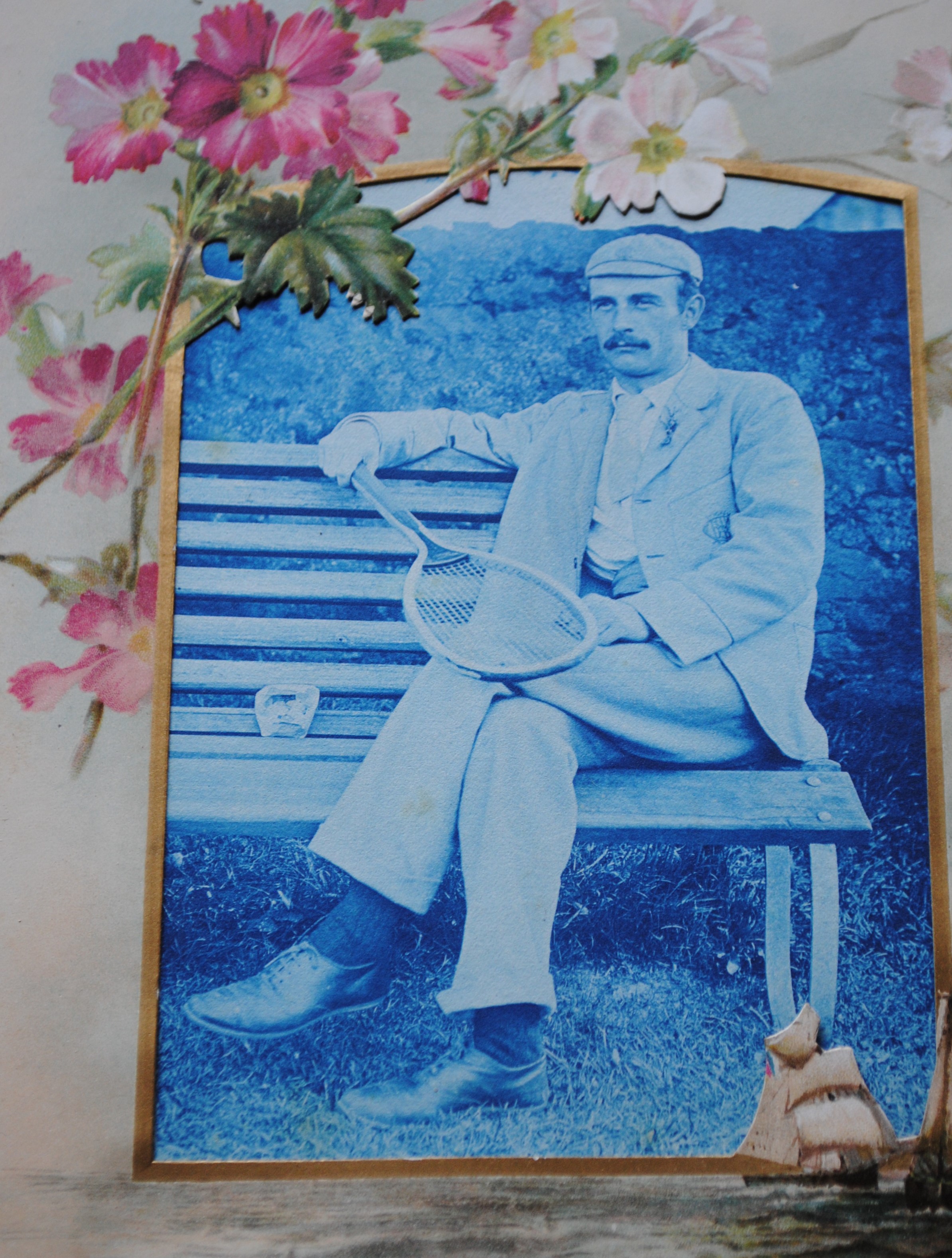
Mary Grant’s family hailed from Inverness where her father worked as an architect. It is a typical story of migration — although she lived in London, Isabella spent holidays with her aunts and uncles in the north of Scotland often at Lossiemouth. Here she is in 1894 at a tennis match in Stotfield, Lossiemouth.

Another intriguing annotated photo from her album is Gilbert R. Betjemann.

Gilbert was a member of their circle, he was a violinist also working in his family’s luxury goods business. Isabella was an excellent amateur pianist, I suspect she accompanied Gilbert (son of the, then, well known conductor Gilbert Henry Beaman Betjemann, whose father was a cousin of John Betjeman, the poet laureate’s grandfather. I mention this because I have been reading John Betjeman’s biography (they dropped the final ‘n’ due to anti-German feelings around WW1) and I remember my Great Granny talking in rather disparaging terms about the ‘rhymes’ of said celebrity poet!

In the March before he died Gilbert made Isabella this little pot which stands on my windowsill to this day. This must have been a wedding present — the monogram ‘IN’ is for her married name and the tiny inscription — his maker’s mark: GR Betjemann fecit, March 1896, 2 months after her marriage.

She married Mitchell Nicholl (1865-1948) another ex-patriot Scot from Kirkcaldy in Fife. He was 8 years her senior and had started as a stock jobber’s clerk in the City some time before 1891 but within 10 years he was listed as a self-employed, Stock Exchange Jobber, married with a 2 year old daughter. It was his father, the sea Captain, I discussed in a previous blog published on 2019/05/08, entitled “In the family — Shipwrecks and Cholera”. He died of cholera in a foreign port having lost everything in a shipwreck.

Isabella and Mitchell Nicoll — social mobility in action — the growing Edwardian middle-class, thanks to sound education and possibly helped by the inability of the class-bound English to fit a Scottish accent into the established order!

c1900, Isabella, with her mother and her daughter. My sons-in-law will read what they may from this image!

Standard